


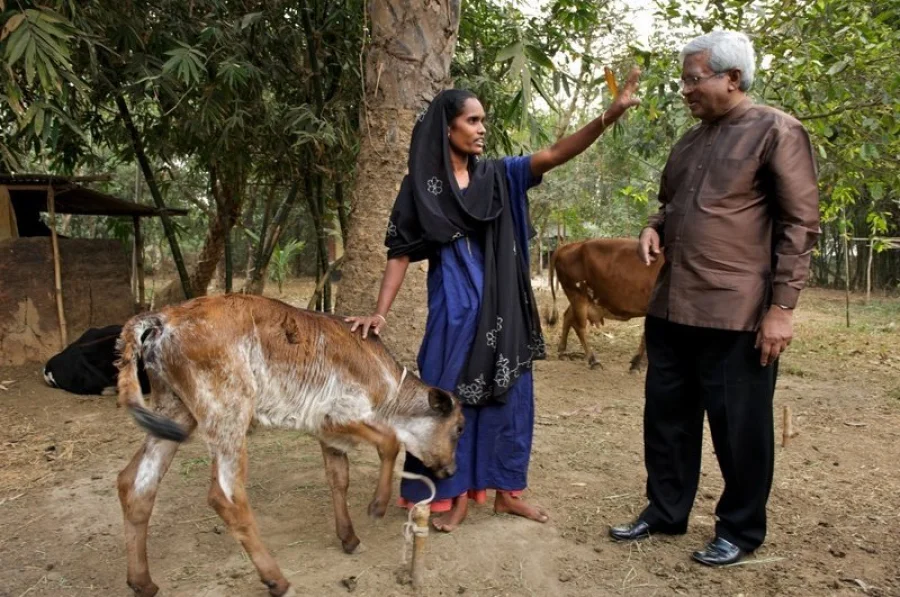
 Abed meets with a Bangladeshi villager who was given a cow as part of Brac's graduation programme Courtesy: Brac
The idea is to give an extremely poor family an asset – say a cow or a goat or bees – that can increase its income over time. Brac is hardly the first group to use this model; another prominent one is Heifer International. But Brac combines the donation with a mix of services that has proved highly effective – including training and coaching on how to use the asset, cash grants to tide the family over while getting a new enterprise started, and help with health care and education.
Over time, the organisation also vastly expanded its reach to countries beyond Bangladesh – renaming itself once more as just "Brac." Today, its graduation model is one of the few whose effectiveness has been established through rigorous testing using randomised controlled trials, meaning researchers compared the income and well-being of people served by the graduation programme with otherwise similar people who did not.
Last May, for instance, Science published the findings of a major randomised trial studying more than 10,000 people in six countries. In five of those countries, those who got assistance modelled on Brac's graduation programme made a little more money, had more to eat and had better mental health than those who did not a year after the programme was over. (It is worth noting that the improvement in incomes and food consumption together was not huge – on average a 5% boost).
A more recent evaluation, released late last year by researchers at the London School of Economics and supported with funding from Brac, analysed the impact of a graduation programme directly administered by Brac for nearly 7,000 ultra-poor families in Bangladesh. Those results were even more impressive: Four years later, their incomes were 37% higher than in the control group. And the impact seven years on was at least as large.
Abed hopes more NGOs and governments adopt the graduation model. Brac has published a detailed guide and “tool kit” to help others create their own versions of the programme. And it has hosted visitors from the governments of Tanzania and Kenya as well as officials from the United Nations who are interested in learning more.
But most important, says Abed, will be to find ways to reduce the cost of Brac's graduation model. Right now it is about $500 per family in Bangladesh. “I think many people in the government are going to look for answers that are slightly cheaper,” he says. So Brac plans to spend the next several years studying the impact of expense-cutting measures: What happens if you reduce the number of visits by the coach who teaches the family how to get income from its cow, for example?
“The question is, what is the trade-off?” he says. “Suppose eliminating costs by half makes the success rate go down by 10%. Well, that might be worth taking.”
But if this makes Abed sound like a pragmatist, he insists he is as idealistic – and optimistic – as ever about the chances for lifting the poorest out of misery. After all, he says, he only needs to think back to how things looked in Bangladesh in 1970. “I have seen such major changes. I don't ever despair.” Abed meets with a Bangladeshi villager who was given a cow as part of Brac's graduation programme Courtesy: Brac
This article was first published on npr.org
