



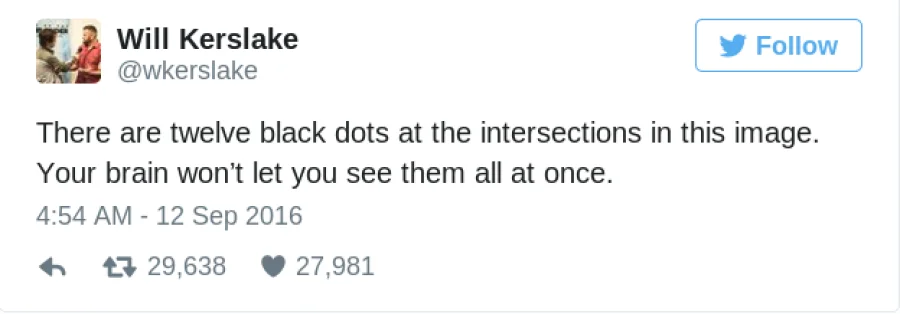
 On Sunday, Will Kerslake, a game developer, tweeted about this image that “the brain can see some black dots but guesses when it fills in the peripheral vision. Because mostly gray lines appear in the periphery, the black dots don’t appear.”
The image is a modification on “the Hermann grid illusion” which consists of black squares made with white lines. Grayish spots appear at the intersections of the white lines, but that is only visible in an individual's periphery.
An article on The Verge quotes a visual scientist from University of Queensland, Derek Arnold who compares the effect of this image as “an existential crisis.” He questions, “How can I ever know what the truth is?” but concludes that visual scientists are well aware “that perception doesn’t always equal reality.”
The image shows a white background with a gray grid which has 12 black dots on the nodes where the lines intersect.
The trick is: even if all the 12 dots are there on the image, some dots appear with every blink as some disappear. An article on TIME explains this happens “because the eye’s stimulated light receptors can sometimes influence the ones next to them, creating illusions.” On Sunday, Will Kerslake, a game developer, tweeted about this image that “the brain can see some black dots but guesses when it fills in the peripheral vision. Because mostly gray lines appear in the periphery, the black dots don’t appear.”
The image is a modification on “the Hermann grid illusion” which consists of black squares made with white lines. Grayish spots appear at the intersections of the white lines, but that is only visible in an individual's periphery.
An article on The Verge quotes a visual scientist from University of Queensland, Derek Arnold who compares the effect of this image as “an existential crisis.” He questions, “How can I ever know what the truth is?” but concludes that visual scientists are well aware “that perception doesn’t always equal reality.”
On Sunday, Will Kerslake, a game developer, tweeted about this image that “the brain can see some black dots but guesses when it fills in the peripheral vision. Because mostly gray lines appear in the periphery, the black dots don’t appear.”
The image is a modification on “the Hermann grid illusion” which consists of black squares made with white lines. Grayish spots appear at the intersections of the white lines, but that is only visible in an individual's periphery.
An article on The Verge quotes a visual scientist from University of Queensland, Derek Arnold who compares the effect of this image as “an existential crisis.” He questions, “How can I ever know what the truth is?” but concludes that visual scientists are well aware “that perception doesn’t always equal reality.”