Data from the last fiscal year shows that remittances from expatriates did not rise as expected while the price of dollars rose to record breaking highs.
In the 2021-22 fiscal year, Bangladeshi expatriates sent remittances worth $21.03 billion to the country, which is 15.12% less than the previous fiscal year.
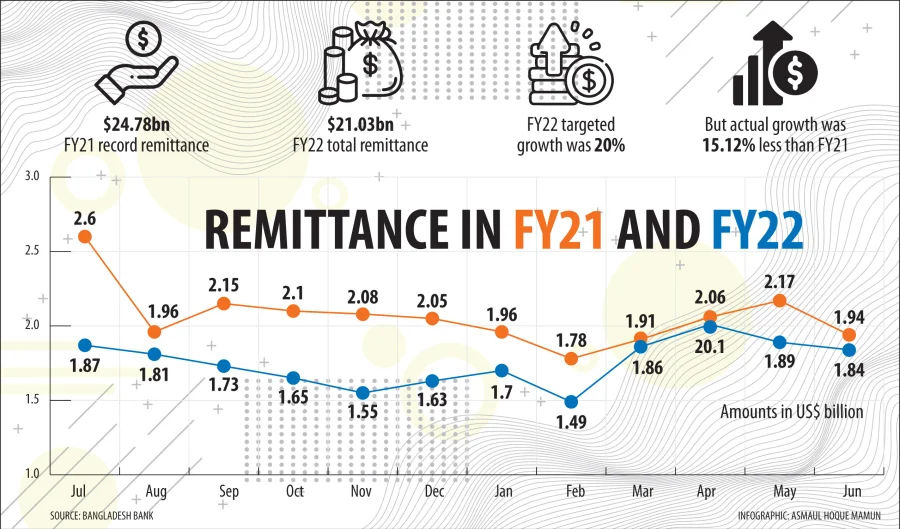
The remittance inflow declined by around 5% in June alone compared to the previous month (May). Expatriates sent nearly $1.84 billion in June 2022 while the amount was around $1.94 billion in May, the central bank figures revealed.
In FY21, the expatriates sent remittances worth $24.77 billion.
The lower numbers might be deceiving, economists believe, pointing out that the remittances might have declined through legal banking channels.
Moreover, the dollar exchange rate available in the banking channels is much lower than what’s available in the open or kerb market for the last few months. This might be another reason behind the decline in remittances through the legal ways, they explain.
During FY21 and the beginning of FY22, the exchange rate of the dollar was around Tk86-87, which is now around 100 in the kerb market.
Asking why remittances declined despite the dollar appreciation and increased incentives from the government in the last financial year, Economic Analyst Ahsan H Mansur, executive director of Policy Research Institute (PRI) said: “Remittances were declining due to several reasons. One of the reasons is that the remittances that came last year were artificial.
In other words, the money that used to come to the country through various means including hundi, came through the banking channel last year due to the closure of travel because of coronavirus. This increased remittance inflow in the last financial year. Now people have started travelling again. All the money is no longer coming through the banking channel. So, remittances are declining.”
“The gap between the kerb market and the bank's money exchange rate is much wider now; Seven to eight Taka. If there is such a gap, people will not send remittances through banking channels. So, you have to adjust the dollar rate in the banking channel with the open market at any cost. The gap should be reduced to Tk1 or 2,” he added.
“It is completely foolish to think that remittances will increase if incentives are given. There is no gain with these incentives. The government is just throwing thousands of crores of taka into the water. The bigger issue is that remittances will only increase if we make it easier to send money through legitimate channels and adjust the dollar rate as well as send skilled people abroad,” Ahsan H Mansur further said.
“The remittance has decreased a bit compared to last year. But considering the pre-pandemic fiscal year, the growth of remittance is correct,” said the Executive Director and Spokesperson of Bangladesh Bank Serajul Islam.
He told Dhaka Tribune: “The time of FY20 is an exception. Normally, we expect $20-25 billion in the fiscal year now. In the pre-pandemic period, that is, before FY20, you will see that it was below the $20 billion mark. As such, it was more than $21 billion last year, which is good enough.”
Asked about the reserves, he said: “As of June 30, our reserves were $41.83 billion.”
Needless to say, the amount of remittances sent by Bangladeshis in FY21 is the highest in the country's remittance history.
But according to Bangladesh Bank data, in the previous three fiscal years before FY21, the overall remittance was $18.20 billion in FY20, $16.41 billion in FY19 and $14.98 billion in FY18.