A number of leading voluntary groups in Bangladesh have emphasized a coordinated approach to continuing voluntary activities to support marginalized sections of the population affected by the Covid-19 pandemic in the country.
Many organizations are working individually or teaming up with other organizations to support the poor and marginalized during the Covid-19 pandemic.
However, in the days ahead, when the situation turns more challenging, coordination among stakeholders will be required to continue such initiatives, according to participants in a webinar.
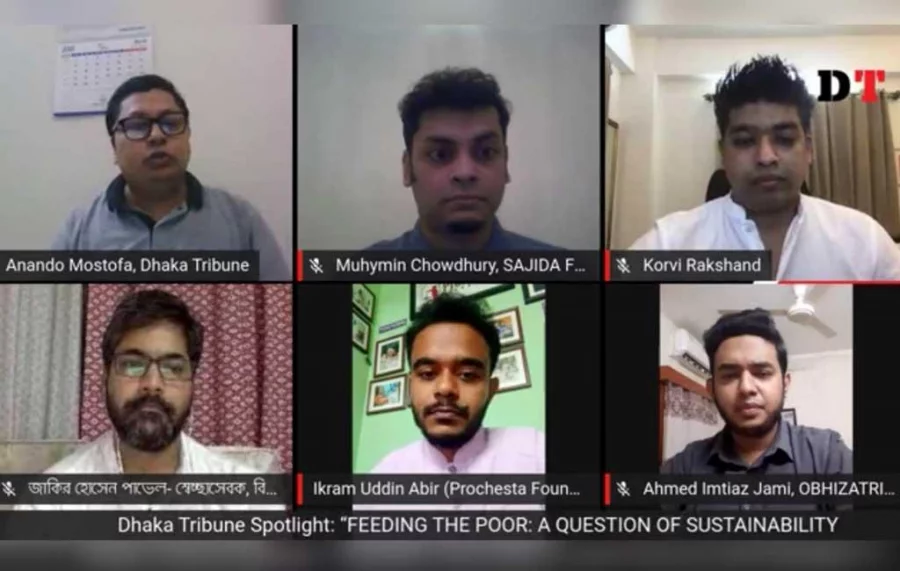
Dhaka Tribune hosted the webinar, titled “Feeding the poor: A question of sustainability”, on Friday night. The webinar was moderated by the head of Bangla department, Anando Mostafa.
Muhymin Chowdhury, head of fundraising at Sajida Foundation; Korvi Rakshand, executive director of Jaago Foundation; Jakir Hossain Pavel, executive member of Bidyanondo Foundation; Ikram Uddin Abir, Proceshta Foundation founder; and Ahmed Imtiaz Jami, founder and president of OBHIZATRIK Foundation, attended the webinar.
During the webinar, the discussants noted that the poor and marginalized along with the small and medium enterprises had been bearing the brunt of the Covid-19 crisis and they would therefore require support in the long run to recover their means of livelihood.
The participation of general people, in addition to that of donors, in fundraising initiatives had been extraordinary since the start of the Covid-19 pandemic, but there would yet be challenges in managing funding in the days ahead, said Jaago Foundation Executive Director Korvi Rakshand.
“There is no coordination among non-government organizations (NGOs) or voluntary organizations on who is doing what and where. If mapping can be done, then identical voluntary activities will not be repeated at the same location,” he said, adding that similar initiatives had been taken by corporate bodies under CSR funds.
Coordination was required among the whole sector, including the government, voluntary organizations, NGOs and stakeholders for an effective implementation of voluntary activities run via funding from donors, he added.
Ikram Uddin Abir, founder of Proceshta Foundation, which handed over iftar packages to 25,000 people during Ramadan, said the foundation was currently conducting activities by partnering up with multiple organizations due to a lack of funds.
Ahmed Imtiaz Jami, founder and president of OBHIZATRIK Foundation, said the challenges were largely linked to a distribution of relief rather than fundraising.
“Relief materials are donated at the same place by multiple organizations while some areas remain largely ignored. If we can engage in joint collaboration, that will be effective for a sustainable future,” he said.
He also stressed supporting the small and medium enterprises which had suffered heavily because of the countrywide shutdown but were left out of the government’s incentive packages.
“If we can work to support them with income generation activities, then the pressure from relief activities will go down,” he said, adding that ensuring sustainable income for the affected should be a major concern right now.
Muhymin Chowdhury of Sajida Foundation, which works through funding from non-resident Bangladeshis, individual donors, and institutional donors, said fundraising had been on the rise for the last two months, but the purpose and perspectives were changing.
The primary initiatives were solely for Covid-19 prevention activities like hand washing, hygiene maintenance, etc. These had now changed into activities geared to a strengthening of hospital management, he said.
“Our mandate is to stand by people who are in need. The main concern right now is to continue as long as possible with the Covid-19 specific interventions that we have launched,” he added.
Concentrated efforts by the government, donors and stakeholders were crucial for a continuation of livelihood recovery programs, he said.