As the UK, the US, and most countries in Europe have sophisticated health systems, highly connected cities, world class tech companies with access to data on everyone and everything, we all expected that the West would come out with a coherent and swift response to the coronavirus pandemic.
Instead, we find that the health systems have little excess capacity, the connectivity merely reinforces fake news on social media, and the tech companies are unable or unwilling to do contact tracing.
Add to this the lack of sufficient testing, government agencies messing up the testing reagents, policy-makers giving confusing and contradictory directives, modellers promoting models with wildly different outcomes, health organizations giving contradictory recommendations on the use of masks, it is a wonder that anything got done.
The only thing that the experts seem to agree upon is some form of quarantine (now called “social distancing”) and washing one’s hands. And of late there is a growing consensus on the use of face masks.
So, given the less than stellar response of the US and Europe, what should the rest of the world do? So far, the answer seems to be to play the imitation game, namely follow the lead of the US and Europe and lockdown countries to achieve social distancing.
Of course, for poor countries, a difficult question is how do daily wage labourers survive without work during a lockdown? Governments around the world are struggling with this problem.
Is the imitation game going to be the answer to the Covid-19 problem? Let us look at the data on deaths so far and ask some simple questions. We use data provided by the Johns Hopkins University Center for Systems Science and Engineering (JHU CSSE). The sources for this data are US CDC, WHO, European CDC, China CDC, and others.
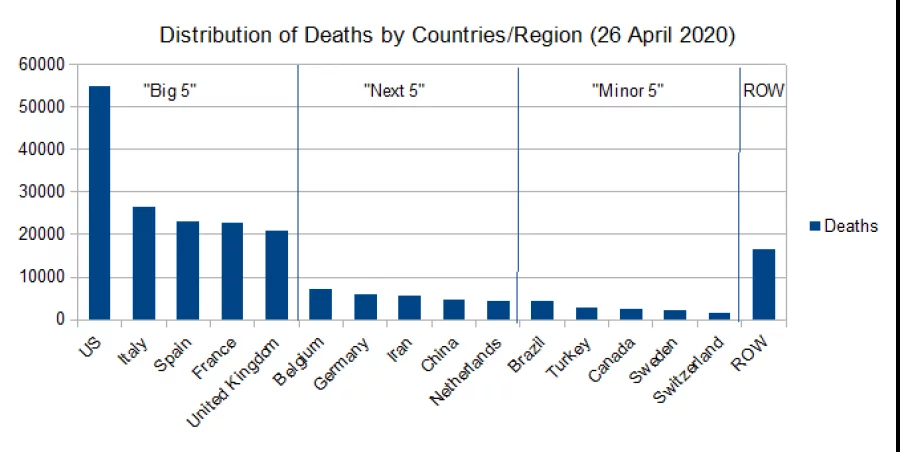
As of April 26, 2020, there were roughly 207,000 deaths around the world according to the data. If we order the countries in descending order of deaths, then we can classify them into four distinct groups -- “Big 5,” “Next 5,” “Minor 5” and “ROW.” The “Big 5” consisting of US, Italy, Spain, France, and the UK account for 72% of all deaths around the world.
The “Next 5” consisting of Iran, Belgium, Germany, China, and the Netherlands account for 14% of all deaths. The “Minor 5” consisting of Brazil, Turkey, Canada, Switzerland, and Sweden together constitute 7% of the deaths. The remaining 170 countries/regions in the list (“ROW”) constitute 8% of the deaths. (The eagle-eyed reader will note that the numbers may not always add up due to rounding! Also the list only includes those countries that have at least one case of Covid-19.)
Therefore as of April 26, the rest of the world (“ROW”) is not doing too badly compared to the “Big 5.” The question is: Why is this? After all, “ROW” includes most of the Global South. Many of these countries have vast populations, weak health systems, and poor infrastructure. There are plenty of articles warning about the catastrophic deluge of cases and deaths that are about to occur in these countries. So why hasn’t this happened so far?
Several explanations have been advanced for this.
1. The epidemic is still in its early stages in the Global South.
2. The virus is more deadly for those over the age of 60, and the Global South has more people under 60 as a percentage of the population compared to the developed countries.
3. Diseases such as TB, malaria, HIV/Aids, dengue, diarrhea etc claim many lives in the Global South and therefore the deaths due to Covid-19 are being swamped by these numbers. This is leading to underreporting of deaths.
4. There is speculation that the transmission of the virus may be slowed by high temperatures and humidity.
Let us look at each of these explanations and consider the consequences.
1. The epidemic is still in its early stages in the “ROW.” The epidemic has certainly affected the countries in “ROW” later than the countries of the “Big 5.” However, this means that those “ROW” countries that have implemented lockdowns have acted relatively early in the epidemic. But there remains the question of whether or not the lockdown was effective. If the lockdown has been effective, then we should see the flattening of the epidemic curve. If not, then the epidemic is still to come.
In either case, these countries now have to deal with what some are calling the “hunger pandemic.” The question of how to support the poor after a month of lockdown is on the minds of policy-makers in all these countries. Therefore most “ROW” countries have to deal with the twin problems of Covid-19 and hunger.
2. The virus is more deadly for people over 60 and many “ROW” countries have a lower percentage of older people compared to the “Big 5.” There seems to be a consensus that the death rates are much higher for older people. For instance, data from the official website of New York City (https://www1.nyc.gov) shows that the death rate per 100,000 people is substantially higher for people over the age of 65. So the age distribution patterns in poorer countries will certainly help. However, since the population is large, this should still translate into a lot of deaths if the epidemic is unchecked.
|
(Source: www1.nyc.gov downloaded April 25, 2020)
3. Diseases such as TB, malaria, HIV/Aids, dengue, diarrhea etc claim many lives in the Global South and therefore the deaths due to Covid-19 are being swamped by these numbers. According to WHO reports in 2018, there were 1.5 million deaths due to TB. Of these deaths, 449,000 were in India, 157,000 in Nigeria, 98,000 in Indonesia, 64,000 in South Africa, 53,000 in DRC, and 47,000 in Bangladesh. So it is certainly possible that due to the large number of deaths from other illnesses, the Covid-19 deaths are not showing up in the statistics.
4. There is speculation that the transmission of the virus may be slowed by high temperatures and humidity. This is speculative at the moment, and there aren’t any peer reviewed studies that have conclusively shown this. However, if we divide the world into three zones approximately based on based on the 30th parallel and the 49th parallel as follows:
North Zone: Countries lying to the North of the 49th parallel as shown in the map. These include Canada, Alaska (the US), the UK, Ireland, Norway, Sweden, Finland, Denmark, the Netherlands, Poland, Russia, and others.
Middle Zone: Countries lying between the 30th parallel and the 49th parallel. These include the US (excluding Alaska), Portugal, Spain, Italy, France, Switzerland, Turkey, Iraq, Iran, Afghanistan, Uzbekistan, Ukraine, Mongolia, China (excluding some southern provinces), South Korea, Japan, and others.
South Zone: Countries lying to the South of 30N: Mexico, Latin America, Brazil, and all countries in South America, Morocco, Algeria, Libya, Egypt, Nigeria, South Africa, and all countries in the African continent, UAE, Qatar, Saudi Arabia, Pakistan, India, Sri Lanka, Bangladesh, Nepal, Bhutan, Myanmar, Thailand, Vietnam, Malaysia, Singapore, China (some southern provinces), Indonesia, Philippines, Australia, New Zealand, and others.
If we look at the number of deaths in the three zones we get the following:
Number of Deaths by Zone (April 26, 2020)
|
(Data Source: Johns Hopkins University CSSE downloaded from GitHub on 27 April 2020)
(Totals for % may not add up due to rounding.)
We see that 94% of the deaths have occurred in the North and Middle Zone. Most of the deaths have occurred in the middle zone. The North Zone has fewer people than the Middle Zone and hence it is not surprising that it has fewer deaths.
Therefore so far the South Zone has only 6% of the deaths around the world due to Covid-19. Whether this is due to the higher temperatures and humidity or because the epidemic is in its early stages in the south, only time will tell.

Should the ROW continue to play the imitation game? And if it does, then what should be imitated? Health systems in the West tend to be intensive in nature. There are sophisticated machines that can do wonders for a patient, but given the costs associated with these machines there are a limited number of such facilities. During the Covid-19 crisis health facilities in Italy, have been overwhelmed by the number of people coming into the system and this has led to the calls for flattening the curve.
It is unrealistic to expect that the ROW will be able to procure the kinds of systems, in the quantity required, if they try and follow the Western model.
Therefore, the South should look at where it has had its greatest successes. These have tended to be relatively low tech, affordable solution that is dispensed rapidly to many people. So the South should look at an extensive model. The oral rehydration therapy (ORT) comes to mind when we think of where the South has had its greatest successes.
In this crisis, there are some obvious things that could be done. Garment factories could produce face masks in large quantities for distribution to people. Pharmaceutical companies could manufacture hand sanitizers and soap manufacturers could produce large quantities of soap for distribution to the general public.
South Africa, which instituted one of the most stringent lockdowns in the African continent, has announced that there are five different levels of social distancing that it will follow. At present, it is in stage five which is the most intensive, however starting from May 1 it is relaxing some of these measures and moving to level 4.
This is so that economic activity can begin again so that those who are in need of income can go back to work. The levels will change depending on how the epidemic evolves in the country.
The South African government is also advising people who can work from home to continue to do so. Restrictions are going to be eased for those in the service sector who have to go to work. Along with this the government is asking establishments that open up, to adhere to hygiene measures. Public transport vehicles have to carry fewer passengers than their capacity to allow for social distancing.
The agriculture, forestry, and fishing sectors will be allowed to resume work, especially for harvesting activities. Certain manufacturing services will be allowed to resume. Although restaurants will still be closed, more of them will be allowed to deliver food. People have to wear masks when they go out and make extensive use of hand sanitizers.
Even in the West, some countries are easing the lockdown. The South therefore has a variety of strategies that it can follow to contain the virus. It has to decide which imitation game to play.
Annex:
Number of Deaths due to Covid-19 by Country (April 26, 2020)
|
(Data Source: Johns Hopkins University CSSE downloaded from GitHub on 27 April 2020)
(Totals may not add up due to rounding.)
Dr Riaz Khan is a mathematician and development professional.