After a three-year hiatus, Dhaka Art Summit 2023 opens February 3, bringing to the public the work of over 160 artist participants at Dhaka's Shilpakala Academy. DAS 2023 is told through the voice of Bonna, a character who speaks from Bangladesh to the world. She is a bold young girl who expresses her dynamic personality fearlessly, refusing to be silenced. DAS artist director and chief curator Diana Campbell talked to Shahirah Majumdar about this year's theme, what to expect, and the role of art in responding to times of crisis.
What does it feel like to be back at Shilpakala after the pandemic?
At the 2020 summit, we had so many people and it was so joyful — a transformation of people who had never met into this beautiful collective bond. Then the pandemic happened, and we weren't supposed to meet anyone we didn't know. We tried to design a summit that helps you forge bonds with people you've never met, and maybe reconsider your bonds with people you're already connected to. But it's a big question: What will the 2023 edition feel like, with that massive gap and world changed in between?
How is this year's theme Bonna a response to everything that's happened in the intervening years?
There's a line in the text: How do we tell a story of crisis while facilitating hope? Bonna, for some, carries this meaning of doom. But almost every culture in the world has a flood myth, and the rainbow that comes after the flood is a promise of hope. Times can be hard, but we're still here to talk about it. Also, I like that it's a young girl who is speaking. She's empowered to ask questions, to play with you. But also to let you know that it's okay for you to ask questions to be loud, make noise, and learn.
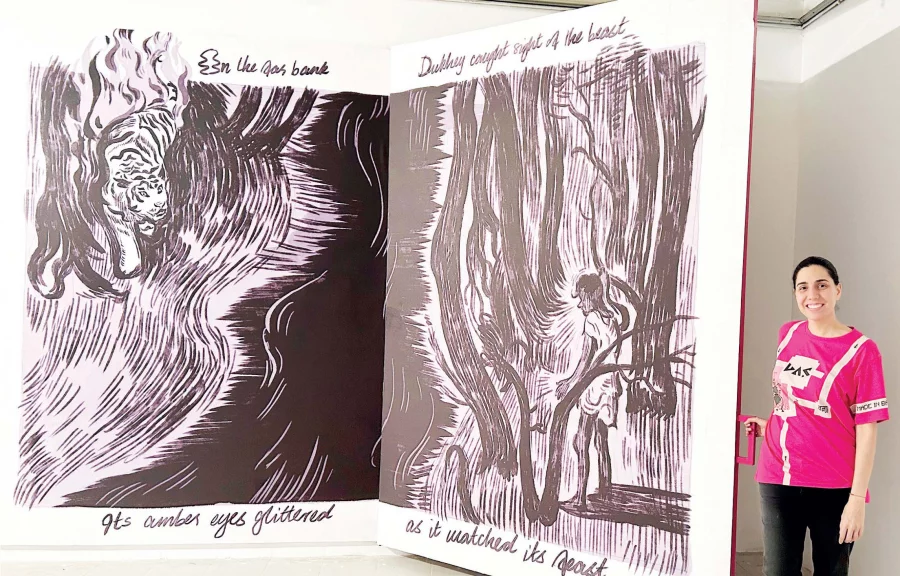 Diana Campbell with Ali Sethi, Amitav Ghosh, and Salman Toor's Jungle Nama imagined as an installation by GOLEM Courtesy of Dhaka Art Summit
How is art a medium for asking those questions and making that noise?
Art is a place where how it is isn't how it has to be. It's a place of imagination, and you can't change anything until you've imagined it. Artists are able to do that in a way that is sensitive, meaningful and, in a way, is the lasting trace of our humanity.
Will there be opportunities for people to make art?
Yes, there are a lot of artworks that are instruction-based work, so you're basically completing the artwork. There's a work by a Slovakian artist Roman Ondak, called Measuring the Universe, another work by David Horvitz with instructions called Change the Name of Days. Some other artists such as Sanjoy Chakraborty create a space where you can draw and make responses. The summit was thought of and envisioned as a participatory space. Your presence is helping build it up
Are there particular pieces you are excited for people to experience?
So many, so many. There's a great work by Nabil Ahmed called Radical Meteorology looking at the first image of the Earth from space, Blue Marble, which has an image of a cyclone over the Bay of Bengal, a harbinger of Bhola, one of the world's deadliest cyclones. There, you're seeing where political violence and ecological violence overlap because that cyclone led to Bangladesh's fight for independence. That video is a good entry point to think about the rest of the show. It's in the round gallery — which is like the "storms have eyes and eyes of storms" gallery — with works by Ayesha Sultana (who has shown at every single Dhaka Art Summit and won the 2014 Samdani Art Award), Safiuddin Ahmed, SM Sultan, and a lot of others. It's an interesting gallery.
This is the sixth edition of DAS. What role does DAS play in the art ecosystem in Bangladesh?
For some artists, every day is a Dhaka Art Summit. They can show everywhere within the infrastructure of Bangladesh's art world. It's harder if you're young, if you haven't had a chance to break out, and maybe if you're working in a medium that's not accepted so much. When I started working here, photography was not really taken seriously within the world of "fine art." That's very different now. We are seeing much more video and performance, architects, writers participating in the summit. We're really trying to create a space where there's a wider definition of what art can be, and of who can be involved. In this edition, we're showing the widest range of practices, from rappers to painters; the widest range of ages, from kids making drawings in To Enter the Sky to artists in their 70s, such as Antony Gormley, or legendary dead artists, like Satyajit Ray; and also art from the widest range of locations in Bangladesh involved in producing the artworks, from Khulna to Gaibandha to Thakurgaon. The summit happens over nine days, bringing together a lot of people in a short period of time, which makes it feel like a festival or celebration.
 Chant For Hope (Rehearsal 2023). Commissioned by Samdani Art Foundation in Partnership with KANAL - Centre Pompidou, Brussels. Courtesy of the artist Shahrear Kabir Heemel
What is it like working with the Samdanis?
We've been working together for 10 years and have different roles and strengths. It's a good team energy of being locally rooted, internationally aware. They're not trying to be curators. They make any artist who I invite feel super welcome and engaged with Bangladesh, a country they love very much and bring others to fall in love with too. They are lovers of art who are hands on with the vision, logistics — and incredibly warm hospitality — to help professionals bring the summit to its fullest potential.
How has the government of Bangladesh been as a partner?
It is clear that art and culture are important to the Bangladeshi government. It will be interesting to see how they adapt to a changing world and support their young artists, who reflect the future, to have agency and visibility. The Shilpakala Academy has expanded; it's much bigger now. How will they support the growth of this generation to be able to utilize the space to its best potential?
What kinds of people will we see at the Dhaka Art Summit?
All kinds! From people that have never seen an art show before to directors of major museums, and collectors from all over the world. It's really a huge cross section.
What would say to somebody who doesn't know anything about art to make them feel invited?
I would say, we've all been drawing since we were kids; it's just trained out of us. This is a place to tap into your inner child, remember what it feels like to have those coloured pencils and paper. And that it's OK to draw outside the lines. It's a place to be curious, to feel welcome, to have fun, feel, and think. There's no tickets. No one's judging you based on what you know.