



The leadership landscape of Bangladesh football changed dramatically in late 2024. After 16 years of Kazi Salahuddin’s tenure, a new administration led by BFF president Tabith Awal took charge following the October 26 election.
Among the new faces in the executive committee is Fahad Mohammed Ahmed Karim, vice-president of the Bangladesh Football Federation. A prominent figure in the country’s sports industry, Fahad is the president and CEO of K-Sports, one of Bangladesh’s leading sports marketing and management companies.
Fahad joined the federation with a strong background in sports marketing, brand building and digital engagement. Since taking office, he has been particularly active in sponsorship, marketing strategy, digital media growth and the inclusion of diaspora players in the national team setup.
In this extensive conversation with Dhaka Tribune’s Fazley Rabbi Moon, Fahad reflects on the federation’s first year under the new committee, the resurgence of fan engagement, Bangladesh’s near miss in the AFC Asian Cup qualifiers, futsal’s future, and why building a FIFA-compliant stadium has become an urgent national priority.
Q: It has been about 15 months since the new committee took charge. How do you assess the journey so far?
Fahad Karim: You have to start by looking at the situation we inherited. Football in Bangladesh had many challenges at that time. There were financial issues, there were sanctions from FIFA, and sponsorship was extremely limited.
However, two things we received in good condition. One was the domestic league structure — credit goes to the previous committee for keeping that operational. The second was women’s football. The women’s team had been built very well and was performing strongly.
But apart from those areas, there were major difficulties. Our president Tabith Awal made it clear from day one that the first priority was to resolve the FIFA financial sanctions. Alhamdulillah, we managed to do that within three months.
Another objective was to revive football’s connection with fans. I personally don’t believe in phrases like “golden past” or “future promise”. My belief is simple: football should receive what it deserves. It is the most popular sport in the world and Bangladesh is a football-loving country. Our fans deserve quality football and a vibrant football culture.
In that sense, I believe we have been able to bring a wave of excitement back. The home matches we hosted saw full stadiums again — fans fighting for tickets, intense atmospheres and strong engagement. That was definitely one of our targets.
Q: Beyond matchday excitement, what structural changes have been introduced?
Fahad: Our president also emphasized running the federation in a more professional manner. This is a long process. Sports federations in Bangladesh traditionally operate in a very hands-on way, so shifting towards a structured professional system takes time.
But we have started that process.
For example, we have introduced internal review mechanisms and audit structures. Transparency and compliance are extremely important because football cannot move forward without proper governance.
If you run an organization professionally, many problems automatically disappear.
Q: Marketing is one of your core responsibilities. What progress have you made there?
Fahad: When we first arrived, we had maybe three or four sponsors and they were covering less than 20% of our financial needs.
Over the past year that number has changed dramatically. Today sponsors cover roughly 60-70% of our operational requirements.
That is a big improvement, though we still have work to do. My personal goal is simple — when I leave this position, I do not want the federation to operate at a deficit. All planned expenses should ideally be covered by sponsors or partners.
The biggest challenge in football marketing is perception. Football had been severely undervalued in the past. When a product is undervalued for a long time, it becomes very difficult to suddenly raise its value.
So we are trying to change that through numbers, data, and future projections.
Q: BFF’s social media presence has grown significantly. How important has that been?
Fahad: Digital media is extremely important because it is the direct connection between the federation and the fans.
When we arrived, the BFF Facebook page had around 700,000 followers and posts were very irregular. We decided to completely revamp the digital strategy.
Now we have around 1.9 million followers — and the growth has been entirely organic. No boosted posts, no paid promotion.
The engagement levels are very strong. Sometimes even media outlets pick up updates from our posts before press releases are issued.
We are also expanding our digital ecosystem — developing Instagram, LinkedIn, X (Twitter), and revamping the official website. Globally, football federations rely heavily on these platforms, especially in FIFA and AFC ecosystems.
Q: If you had to name the biggest achievements of this period, what would they be?
Fahad: Without question, the biggest success is our women’s team qualifying for the AFC Women’s Asian Cup finals. That achievement is historic.
The scale of that success is enormous and sometimes people underestimate it. It puts Bangladesh in a completely different league of Asian football.
Another major success is bringing fans back to stadiums.
For many years, stadium culture was almost absent. But recently we saw full-house matches again. That atmosphere — fans fighting for tickets — is something we hadn’t experienced in a long time.
Q: One issue frequently discussed is stadium infrastructure. How serious is this challenge?
Fahad: It is a very serious challenge.
The reality is that Bangladesh does not currently have a fully FIFA-compliant stadium.
Think about it — as a member association, we often have to go through multiple approval layers just to host a match. That should not happen.
Globally, modern stadiums are designed for fan comfort and entertainment. Our facilities are still far behind.
That is why building or renovating a FIFA-compliant stadium is one of the most important priorities for the federation.
Our president is very determined about this. Either we acquire land and build a new stadium using FIFA funding, or we renovate an existing one to meet FIFA standards.
But one way or another, it has to happen.
Q: The inclusion of diaspora players like Hamza Choudhury created huge excitement. How significant has that been?
Fahad: Hamza’s impact has exceeded all expectations — both on and off the field.
His presence acted like the boost of a rocket launch for Bangladesh football. The energy and attention it generated were incredible.
Of course, the federation has to maintain that momentum through proper planning and development. But the initial spark was far beyond what anyone anticipated.
At the same time, bringing in diaspora players increases competition within the national team. That competition ultimately improves the quality of football.
Q: Looking back at the AFC Asian Cup qualifiers, how close were we to qualifying?
Fahad: To be honest, we didn’t just have a chance — we actually had qualification in our hands.
For example, in the away match against India in Shillong we missed several clear chances. There was no reason we shouldn’t have won that match.
Against Singapore at home we played well but perhaps lacked the sharp attacking edge we showed earlier.
Then there was the Hong Kong match — one of the best performances I have seen from a Bangladesh team. The atmosphere was incredible and our players fought brilliantly.
And the dramatic match where we lost 4-3 after leading and then equalizing… it felt like watching a World Cup final.
In the end, we missed a huge opportunity. But the performance showed that Bangladesh can compete at that level.
Q: How can the national team maintain momentum over the next few years?
Fahad: In football there is only one solution — play more matches.
We are trying to utilize every FIFA window. We already have matches scheduled in March and June, and hopefully SAFF will take place later in the year.
At youth level we are also participating in multiple tournaments including SAFF and AFC competitions. These players will form the future national team.
More matches, more camps, more competition — that is the only way forward.
Q: Domestic football development is another major concern. What progress has been made there?
Fahad: Last year we successfully held the National Championship, which was extremely difficult mainly because of sponsorship challenges.
But we managed to do it.
More importantly, we have started Under-15 and Under-17 national leagues. These tournaments can be real game-changers.
When you organize nationwide competitions at those levels, you automatically create a scouting system across the country. Talent will emerge not just from Dhaka or Chittagong but from every district.
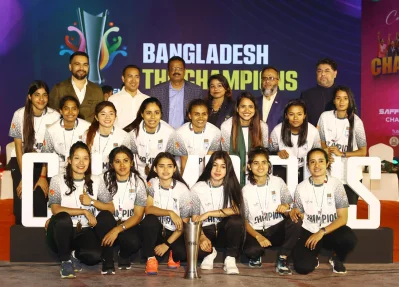
Q: Bangladesh recently achieved success in futsal. What are your plans for that discipline?
Fahad: Futsal has huge potential in Bangladesh.
The way boys and girls play in small spaces across the country shows that the natural skill set is already there.
However, futsal is currently completely amateur here. We need to make it at least semi-professional so that players can actually dream of becoming futsal professionals.
Our plan is to establish a regular national futsal league for both men and women. We will also organize international friendlies and university-based scouting programs.
I strongly believe that in futsal Bangladesh has a realistic chance of competing at Asian level if we nurture it properly.
Q: Finally, what philosophy guides your work at the federation?
Fahad: For me the most important word is intent.
If the intent is genuine, everything else becomes possible — compliance, sponsorship, development, better football.
Bangladesh is a football-loving nation. Our responsibility is simply to create the structures that allow the sport to flourish.
And if we do that properly, football in Bangladesh will naturally rise to where it deserves to be.
