A logical question in everyone’s mind is -- what proportion of the total population is actually infected? To answer this question one would require the data on infection from a random sample of the population.
Unfortunately, no country is dealing with a random sample as all countries are testing symptomatic and sick patients. Worldometer is continuously presenting updated data. A portion of their dataset for some countries is presented in the table below.
The number of “Total Cases” divided by “Total Tests” gives us a value which has been designated in the table as “Hypothetical Infection Rate.”
As can be seen, the hypothetical infection rate varies between less than 1% (for UAE) and approximately 32% (for France). Such a large variation clearly poses a big problem in decision making.
Without additional information, it is not possible to make much sense of these data. For example, Bangladesh’s infection rate is approximately 10%. If this is taken as a true reflection of the number of people infected in the country, then one would conclude that 16.5 million people have been infected -- a frightening proposition.
If a random sample all over the country was taken, this percentage would come down dramatically. Even if we assume the infection rate to be one-tenth, ie 1%, then there are 1.65 million Covid-19 infected people in Bangladesh -- still a daunting number.
Needless to say, not knowing the number of people infected in a particular country can lead to erroneous planning regarding medical facilities’ requirements or when to ease lockdown.
Since the Covid-19 virus has affected countries differently, to understand the hypothetical infection rates, one must divide the countries into two groups. In the first group are those countries which are experiencing an extremely high infection rate.
In the second group are those countries which are experiencing very low infection rates. UAE has been included in the table above as a comparator because this country has performed the highest number of tests per million population.
Germany in Group I and Thailand in Group II have the lowest infection rate having performed the highest number of tests per million people. It is to be noted that countries that have a high infection rate are precisely those countries that have performed very little testing per 1 million population.
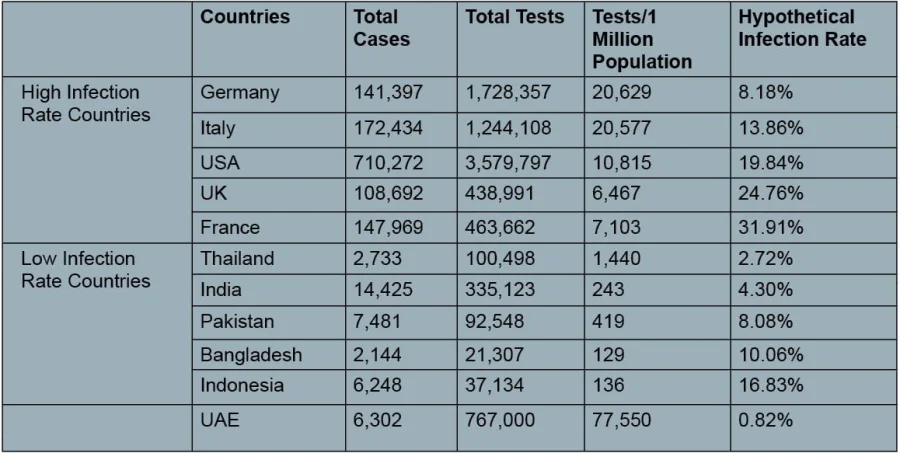
As the number of tests are increased the infection rate comes down in both the groups. This is also borne out by the fact that the UAE has performed a huge number of tests per million people, and shows an infection rate of only 0.82%.
Because of the large number of tests performed, UAE’s infection rate mimics that of a random sample. UK and France in Group I and Bangladesh and Indonesia in Group II with the low number of tests per million people display high infection rates.
To get the most accurate idea of the extent of infection in any country, one would need to test every single person in the country. That is a near-impossible task, especially for a developing country.
To overcome this problem, statisticians have come up with the concept of a “representative sample.” The beauty of the representative sample is that it doesn’t have to be very large.
There are two additional concepts connected with the representative sample, and these are the “margin of error” and “confidence level.” Without delving into the theory of statistics, suffice it to say that for a 1.3% error and a 99% confidence level, the sample size for a population of 165 million is only 10,000.
To get a true random sample, the persons to be tested must be selected “without bias.” In today’s world, with more than half of the population even in developing countries owning mobile phones, this isn’t a difficult task.
Thus, if 10,000 mobile phone numbers are chosen at random (such as in a lottery), and their registered SIM owners are asked to come forward to take a Covid-19 test, it would amount to a random test.
Of course, many would point out that it leaves out those too poor or too young to own mobile phones, but in the present context, where time is of the utmost essence, this error can be tolerated. A truly random sample would ideally be based on household addresses.
Why then are governments across the world not doing this? In terms of the number of tests, which indirectly reflects cost, it is something even developing countries can afford. For example, Bangladesh has already performed more than 21,000 tests.
Thus, the real difficulty lies in conducting tests all over the country and coordinating the results. If the structure is not set up from before, this is not an easy task to organize and implement.
For example, 500 or more tests may need to be conducted in remote locations such as Khagrachori, Sundarbans, Teknaf, etc.
For the case of the US, the challenge will arise from the fact that each state is under the jurisdiction of governors when it comes to testing; coordinating at the country level by the federal government is extremely difficult.
Even estimating the infection rate for a state can be a challenge, especially if the state is large with a sparse population. However, for densely populated small European or Middle Eastern countries, this does not pose much of a challenge, but often governments during pandemic times are reluctant to take on the additional burden and/or are not interested to reveal the true level of infection for socio-political reasons.
Dr Ijaz Hossain is a Professor of the Department of Chemical Engineering at the Bangladesh University of Engineering and Technology (BUET) and an expert in energy and environment.