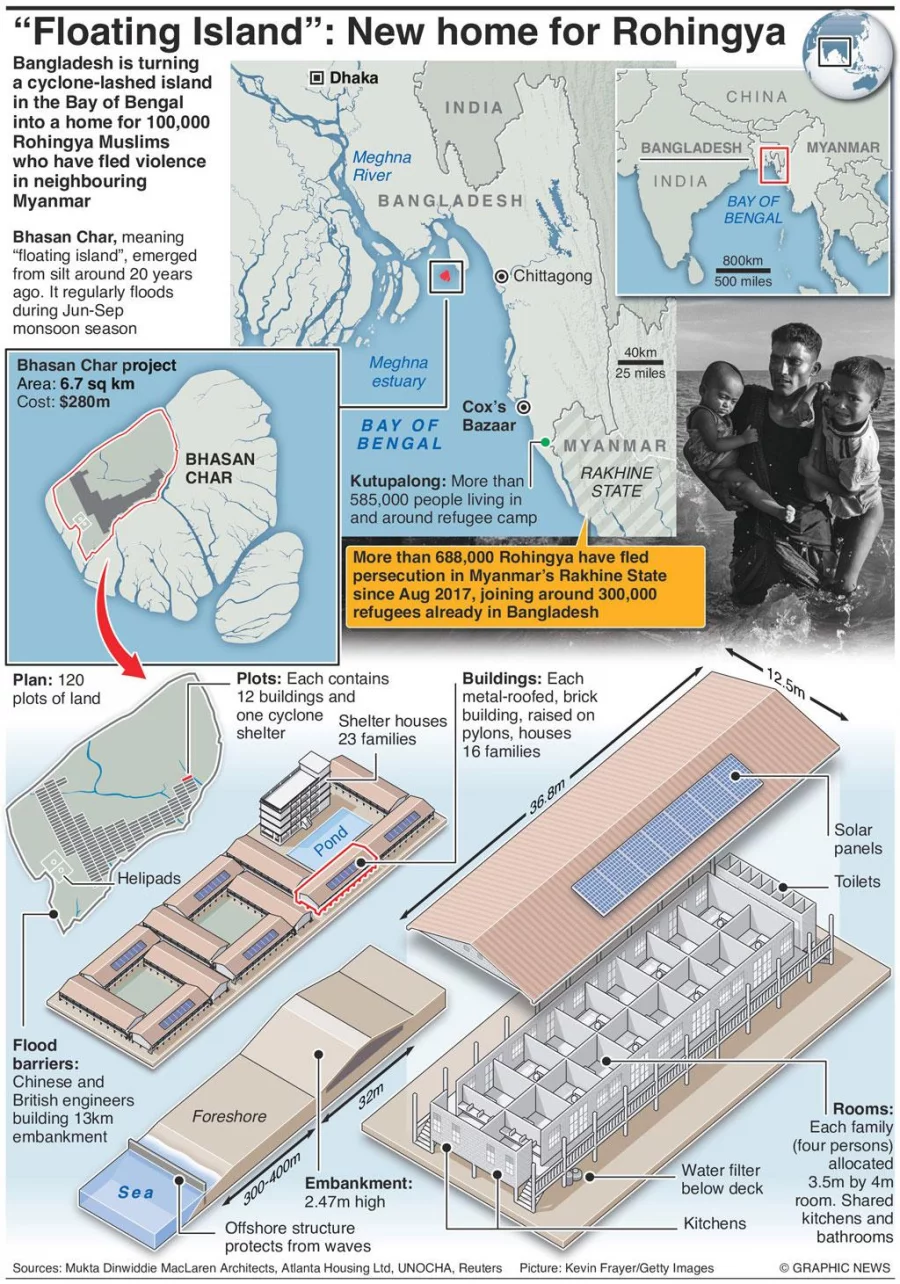
The hundreds of Rohingya refugees on Bhashan Char will not be allowed to leave unless they agree to return home, the Bangladesh government said on Thursday
The 306 Rohingya from Myanmar were put on Bhashan Char in April after being taken off two boats trying to traffic them to Malaysia.
Their plight has been taken up by the United Nations, an international rights group and community leaders, who want them moved to more established refugee camps on the mainland.
"They will stay at Bhasan Char until they are repatriated to Myanmar," Mohammed Khorshed Alam Khan, deputy commissioner (DC) of Noakhali district, which covers the island, told AFP.
He said the refugees are well taken care of and have better facilities than in the overcrowded camps in Cox's Bazar where 700,000 Rohingya fled in 2017 to escape a Myanmar military clampdown.
In April, authorities said the Rohingya would be kept on the island in order to stop the spread of coronavirus in the sprawling refugee camps.
Also Read - HRW: Move Rohingyas from dangerous slit island of Bhasan Char
But Human Rights Watch (HRW) questioned that motivation, and said the refugees were not being treated well.
"Bangladesh authorities are using the pandemic as an excuse to detain refugees on a spit of land in the middle of a churning monsoon sea while their families anxiously pray for their return," said Brad Adams, the organization's Asia representative.
He also asked why authorities were not giving aid workers access to the island settlement.
A Rohingya leader from the Cox's Bazar camps said relatives of those on the island wanted to hold talks with the refugee commissioner.
"We request the authorities to send our children to our families," said Mohib Ullah, head of the Arakan Rohingya Society for Peace and Human Rights, which lobbies for the Rohingya.
HRW said it had received reports that refugees on Bhashan Char had little freedom of movement or adequate access to food, safe water and medical care.
A government official involved with the case rejected the criticism, but admitted some refugees wanted to be reunited with their families.