Ishwardi upazila in Pabna district on Monday recorded the highest temperature at 43 degrees Celsius in Bangladesh this year, according to Bangladesh Meteorological Department.
In Dhaka, the temperature dropped to 38.1 degrees Celsius on Monday from the highest of 40.6 degrees Celsius on Sunday.
Severe heat wave is sweeping over Khulna division and the districts of Dhaka, Faridpur, Gopalganj, Manikganj, Narayanganj, Rajshahi and Pabna.
This heat wave may continue till April 19, according to Met office.
However, there may be rain or thunderstorm in Barisal, Chittagong and Sylhet divisions.
 Dhaka Tribune
Meanwhile, Rajshahi and Chuadanga recorded at 42.6 degrees Celsius and 42.5 degrees Celsius respectively.
Rajshahi has recorded such a high temperature after about nine years since May 21, 2014.
On May 21, 2014, Rajshahi recorded a temperature of 42.6 degrees Celsius, on June 2, 2005, it was 42.8 degrees Celsius. Apart from this, on May 18, 1972, the maximum temperature in Rajshahi reached 45.1 degrees Celsius.
Meanwhile, the maximum temperature in Rajshahi was 40.5 degrees Celsius on Sunday. Temperatures that were recorded on Saturday was 39.5, Friday 40.6, Thursday 40.5, Wednesday 39.1 and Tuesday 38.1 degrees Celsius.
 Dhaka Tribune
According to Rajshahi Meteorological Office, rain is likely after Tuesday. If it rains, the temperature may drop a bit.
Rajib Khan, senior observer of Rajshahi Meteorological Office, said that the temperature is increasing continuously. As the temperature is increasing, it is difficult to say where the mercury will stop in the future. But if it rains, the temperature will drop.
Autorickshaw driver Mofizul Islam said: “Eid is ahead. When I go out in the morning with an autorickshaw, I don't find people because of the weather. I can't even make Tk500 driving till 2pm.”
On the other hand, the highest temperature in Bangladesh this year was recorded in Chuadanga at 42.5 degrees Celsius on Monday afternoon.
A very severe heatwave is flowing over the district.
People's lives are coming to almost standstill due to the very severe heatwave.
The highest temperature in the country has been recorded for almost two consecutive weeks this season in Chuadanga.
 Dhaka Tribune
The district administration is warning the general public not to go out without essential work in severe heat.
Previously, the Chuadanga district administration alerted the city and village people by miking to avoid going outside unless necessary.
Apart from that, the district has seen an increase in heat-related illnesses such as heat stroke, diarrhoea, and pneumonia in children.
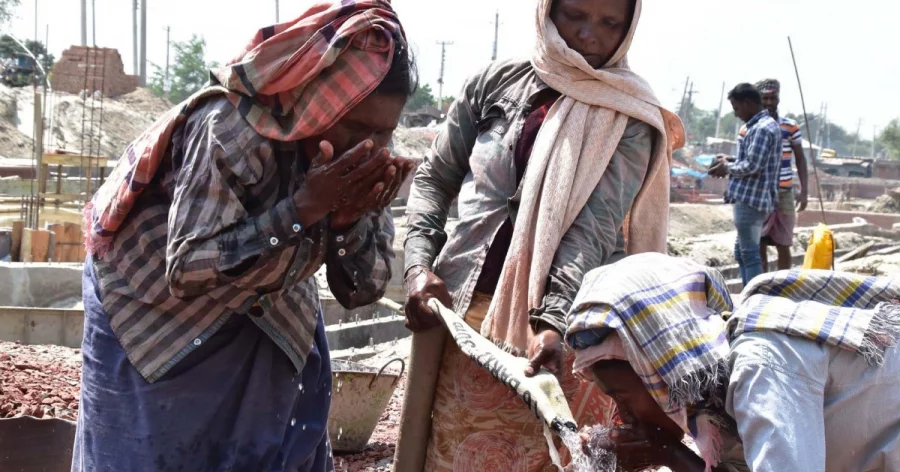
Day labourers, rickshaw pullers, van pullers, and farmers have been suffering the most due to the ongoing heatwave.
Besides, for the 10th consecutive day in Kushtia, life has been disrupted due to intense heatwave.
At the same time, sick adults and children are being admitted to hospital with severe diarrheal illness.
Saidur Rahman, officer-in-charge of Kumarkhali Meteorological Observatory in Kushtia, said that the maximum temperature was recorded at 41.2 degree Celsius at 3pm on Monday. It is the highest temperature in the district this year.
 Dhaka Tribune
The maximum temperature recorded in the district on Sunday was 40.4 degrees Celsius. Also, the maximum temperature recorded in the district on Saturday was 40.8 degrees Celsius. The weather forecast says that this mercury may continue for a few more days in the scorching heat.
Marfat Ali, a tea shopkeeper, said: “On the one hand, Ramadan is going on, on the other hand, due to the intense heat, sales have decreased completely. I don't know what to do in Eid.”
Resident Medical Officer (RMO) of Kushtia General Hospital Dr Taposh Kumar Sarkar said that the number of heat-related children is increasing every day. The hospital has about five times more patients than the number of beds in its children's ward.
The heatwave is sweeping across the country since early April, making the life of people miserable. Public life has been overwhelmed by the heat wave.
Our Rajshahi correspondent Abdullah Al Dulal and Kushtia correspondent Kudrote Khuda Sobuj contributed to the story