Bangladesh is among the 20 countries worst affected by Covid-19 but is still lagging behind in testing and shows the lowest testing rate in Asia.
The National Technical Advisory Committee for Covid-19 (NTAC) has recommended the government to conduct a minimum of 20,000 tests per day, but the highest number of tests conducted in a single day in the country is 14,088 across 50 labs yesterday.
A total of 372,365 tests have been conducted in Bangladesh, so far, with 60,391 confirmed cases of Covid-19.
A total of 2,828 new cases of Covid-19 were confirmed in the country yesterday, and 30 more deaths took the overall death toll to 811. The mounting death toll and increasing rate of infection in the country clearly highlight the need to quickly ramp up testing and contact tracing.
The number of Covid-19 testing labs in Bangladesh doubled over the past month, but a lack of Real-Time PCR machines and backlogs at the laboratories continues to hamper efforts to control the transmission of the novel SARS-CoV-2 coronavirus.

The recent withdrawal of the two-month-long lockdown (general holiday) and resumption of public transport systems threaten to make the outbreak significantly worse, especially without a significant increase in the testing capacity.
Lack of PCR machines, scarcity of equipment
State-run facilities across the country are now using 50 labs to conduct tests, most of them having only one Real-Time PCR machine. Each PCR machine is capable of testing 94 samples at once and takes seven to 10 hours to get the results of a batch.
Microbiologist Samir Kumar Saha, executive director of Child Health Research Foundation (CHRF), explained the process.
Specimens need to be sorted in tubes according to where they came from, he said before adding: “We have to neutralize, meaning deactivate the virus so that they die, and later on we add the reagent to those specimens.”
According to Saha, the RT-PCR machine detects how the specific gene (Sars CoV-2 specific gene) of RNA is multiplying or growing.
“More RNA means more virus in the body,” he said.
“It is not only about the machines for testing. There is a shortage of VTM [viral transport media] tubes and swab sticks as well,” he added.
There were only 333,693 swab sticks and 31,982 swab collection kits in stock as of May 31, according to the Director-General of Health Services (DGHS).
Backlogs at labs
Districts in the north-western, southern and south-western regions are conducting fewer tests than other parts of the country.
Outside Dhaka, 24 labs are conducting tests with less than 30 machines, and the turnaround of tests is getting longer due to backlogs.

The lab at Sylhet MAG Osmani Medical College is not able to test all the samples collected in a day due to a lack of PCR machines.
“Out of 405 samples collected on Friday, we tested 192 samples, the highest so far,” said Vice-Principal Shishir Ranjan Chakraborty.
Shockingly, Rangpur Medical College had to curb sample collection to cope with the backlog.
“We had to stop over 300 samples from coming in every day,” said Principal Prof Nurunnabi Laizu of the medical college, where 188 samples are being tested per day in two shifts.
“We have fixed 25 samples for each of the four districts, 40 for the city corporation, 20 for Rangpur Medical Hospital, 20 from the coronavirus hospital here, and 18 from law enforcement,” he said, adding: “At least 3 machines are needed in Rangpur.”
To lessen the backlog, 227 samples were sent to DGHS recently.
Of the remaining labs, Chittagong Veterinary and Animal Sciences University tested 147 samples of the 317 collected on Friday, Narayanganj 300-Bed Hospital tested 282 out of 302 collected, and Gazi Covid-19 PCR lab in Narayanganj tested 283 out of 530 samples collected the same day.
Only 6 state-run labs for Dhaka
Even though Dhaka is the epicenter of the pandemic and has contributed the highest proportion of cases, samples from the capital are being tested at only six state-run hospitals.
The capital city managed to test only 6,117 samples on Friday, in 26 hospitals — private, public, educational institutions, and non-government institutions — in Dhaka. 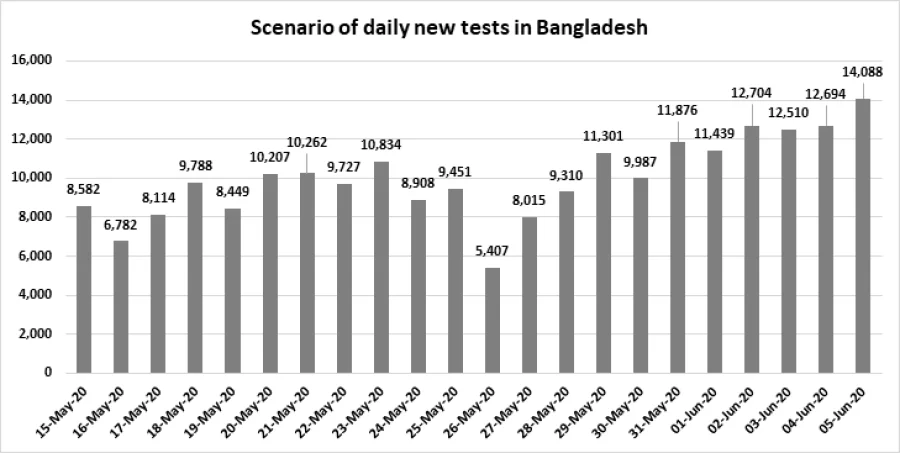
IEDCR, National Polio, Measles and Rubella Laboratory at the Institute of Public Health (NPML-IPH), and National Institute of Laboratory Medicine and Referral Centre (NILMRC), Bangladesh Livestock Research Institute, National Institute of Preventive and Social Medicine (NIPSOM), Centre For Advanced Research In Social Sciences are dedicated for only Dhaka city patients.
Bangabandhu Sheikh Mujib Medical University (BSMMU), Dhaka Medical College and Hospital (DMCH), Armed Forces Institute of Pathology (AFIP) at Bangladesh University of Professionals (BUP), Sir Salimullah Medical College, Kurmitola General Hospital, Central Police Hospital and Mugda Medical College test samples from their patients, only.
Meanwhile, three non-government institutions — the Child Health Research Foundation (CHRF), International Centre for Diarrhoeal Disease Research, Bangladesh (icddr,b), and the institute for developing Science and Health initiatives, ideSHi — are assisting the government by testing samples at their labs.
A total of 10 private hospitals out of 17 authorized, with very small testing capacity, are running tests of their own will.
The Child Health Research Foundation (CHRF) has two machines, said it’s Executive Director Samir Kumar Saha.
“We could not test over 300 samples in any way, though we are working in 3 shifts round-the-clock,” he said, adding that more and more samples have been coming in after Eid-ul-Fitr, which is creating a backlog.
Delays in getting results at the districts
Because of the backlog, some districts are at times getting no test results, and sometimes getting fewer results compared to the number of samples sent in a day.
Sherpur, a north-eastern district, received no results last Thursday and Saturday.

“We got the results of just 11 samples on Friday, though we send 70 to 80 samples every day,” said Sherpur Civil Surgeon Abul Kashem Mohammad Anwarur Rauf.
“As we got no results on Thursday and Saturday, it means we only got 11 results in the last three days. We have 229 samples pending in the lab,” he added.
Narsingdi, considered as one of the hotspots for coronavirus, is getting results three days after samples are provided.
Ibrahim Titon, the civil surgeon of the district, said: “We are getting results late, so far. Yesterday (Saturday) we got the result of samples provided on Wednesday.”
Inadequate number of medical technologists
A small number of medical technologists [MT] were trained through short video conference sessions to collect swabs after the coronavirus pandemic unfolded in Bangladesh.
No technologists were appointed in the state-run hospitals in the last 11 years. In 2018, the DGHS reported that posts of 2,736 technologists out of a total 7,920 at medical college hospitals were vacant.
Anwarur Rauf, the civil surgeon of Sherpur, said there is no medical technologist at Sherpur Sadar upazila hospital.
In three other upazilas, there is only one MT out of two posts. The district hospital has two more MTs.
There are only three drivers against six ambulances, he said, and no permanent ward boys — 28 ward boys working through outsourcing have not gotten salaries for the last one year — making it difficult to collect swabs and treat Covid-19 patients.
In the wake of the rising number of cases and rate on infection, the Directorate General of Health Services (DGHS) earlier told Dhaka Tribune it “needs time” to increase testing capacity.
“It’s not easy to import testing machines. Moreover, we need to maintain biosafety standards to set up new labs,” said DGHS Additional Director Nasima Sultana.
Of the recent backlog, she said: “There are technical problems going on with our machines. We also have a limited capacity.”
The United Kingdom has tested 61,474 samples per million, USA 52,203, India 2,710, Pakistan 2,481, and Nepal 5,974, Bangladesh has the lowest testing rate of 1,805 per million, as per Worldometer’s statistics until May 31.