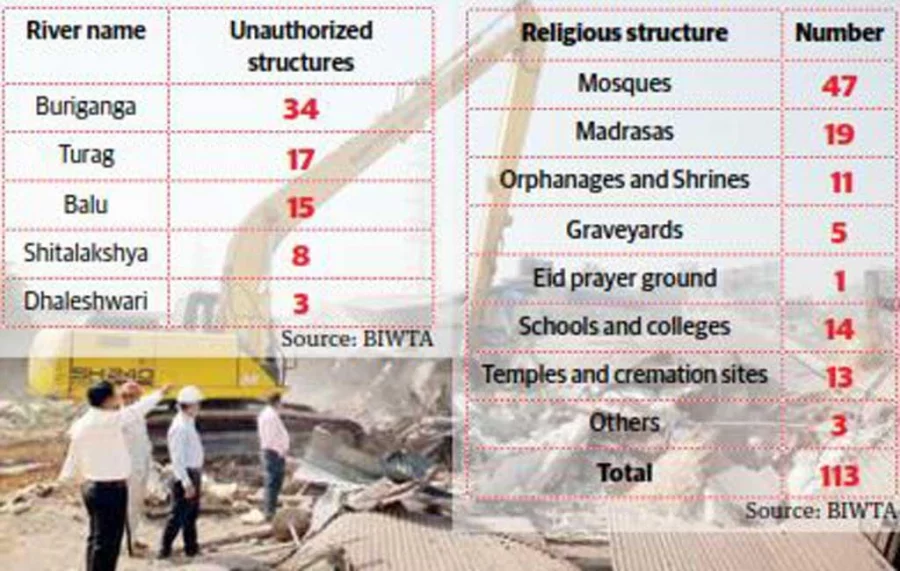
The Bangladesh Inland Water Transport Authority (BIWTA) has identified 96 unauthorized religious structures along five rivers in Dhaka.
The Ministry of Shipping has already started the process of relocation of unauthorized religious structures that are preventing the construction of walkways alongside riverbanks in an ongoing beautification project.
The authorities have no initial plans of demolishing the unauthorized structures.
State Minister for Shipping, Khalid Mahmud Chowdhury, at a meeting said: “Do not spread any message saying that the government will demolish the mosques. We have no plans to demolish mosques or other religious unauthorized structures.”
Khalid Mahmud met with representatives of the unauthorized religious structures at BIWTA headquarters in Dhaka on Tuesday.
The government has thus far removed about 12,396 illegal structures from the port areas of Buriganga, Turag, and Balu rivers this year, according to the shipping ministry.
According to the BIWTA report, of the unauthorized religious structures identified so far, 83 are mosques, madrasas, orphanages, shrines, graveyards, and Eid prayer grounds for Muslims. 13 structures are temples and cremation sites of the Hindu community.
Besides the above 96 unauthorized religious structures, there are also 14 schools and colleges built illegally by locals. The unauthorized religious structures are on the banks of the Buriganga, Turag, Balu, Shitalakshya, and Dhaleshwari rivers, said the report.
The unauthorized mosques, madrasas and orphanages are mostly along the Buriganga river and are mostly in the Sutrapur, Kamrangirchar, and Jhawchar Bazar areas of Dhaka, the report said.
‘Structures not unauthorized’
Most of the founders, mosque committee members, or imams of the mosques along the five rivers say that the structures are “not unauthorized” as they all have legal documents.
They also demanded the walkway be built avoiding and bypassing the mosques. If not possible, they have urged the government to build new mosques in place of the existing ones.
“The Noor Mohammadia mosque was founded around 30 years ago and we also have all legal documents of the land,” said a representative of the mosque at the meeting.
In reply, the State Minister for Shipping, Khalid Mahmud Chowdhury, said: “It might be that you have the documents but you also know how you got them. Some administration officials of government, like the UNO [upazila nirbahi officer] and AC of Land [assistant commissioner] are corrupt, converting illegal documents into legal ones.”
“Politicians or people with political influence can also do such corruption in Bangladesh,” he added.
“Anyone can simply understand by looking at the noted religious structures whether they are on the riverbanks or not. No one needs to see the documents,” he added.
He showed some photographs of the unauthorized religious structures on a projector at the meeting.
“If the government wants to demolish any mosques, they are required to build new ones,” another mosque committee representative said.
“We are planning to form a committee in this regard with officials of the Ministry of Religion and the Islamic Foundation of Bangladesh, as well as community leaders from the Muslim and Hindu communities,” said Khalid Mahmud.
“According to a study, around Tk250 crore is needed to relocate the unauthorized religious structures. The government can easily allocate such funds,” he added.
Among others, Secretary of Shipping, Abdus Samad, BIWTA Chairman Commodore M Mahmub-ul Islam, Deputy Commissioner of Gazipur, S M Tariqul Islam, and Deputy Commissioner of Narayanganj, Jasim Uddin, attended the meeting.
The Bangladesh Inland Water Transport Authority (BIWTA) has identified 96 unauthorized religious structures along five rivers in Dhaka.
The Ministry of Shipping has already started the process of relocation of unauthorized religious structures that are preventing the construction of walkways alongside riverbanks in an ongoing beautification project.
The authorities have no initial plans of demolishing the unauthorized structures.
State Minister for Shipping, Khalid Mahmud Chowdhury, at a meeting said: “Do not spread any message saying that the government will demolish the mosques. We have no plans to demolish mosques or other religious unauthorized structures.”
Khalid Mahmud met with representatives of the unauthorized religious structures at BIWTA headquarters in Dhaka on Tuesday.
The government has thus far removed about 12,396 illegal structures from the port areas of Buriganga, Turag, and Balu rivers this year, according to the shipping ministry.
According to the BIWTA report, of the unauthorized religious structures identified so far, 83 are mosques, madrasas, orphanages, shrines, graveyards, and Eid prayer grounds for Muslims. 13 structures are temples and cremation sites of the Hindu community.
Besides the above 96 unauthorized religious structures, there are also 14 schools and colleges built illegally by locals. The unauthorized religious structures are on the banks of the Buriganga, Turag, Balu, Shitalakshya, and Dhaleshwari rivers, said the report.
The unauthorized mosques, madrasas and orphanages are mostly along the Buriganga river and are mostly in the Sutrapur, Kamrangirchar, and Jhawchar Bazar areas of Dhaka, the report said.
‘Structures not unauthorized’
Most of the founders, mosque committee members, or imams of the mosques along the five rivers say that the structures are “not unauthorized” as they all have legal documents.
They also demanded the walkway be built avoiding and bypassing the mosques. If not possible, they have urged the government to build new mosques in place of the existing ones.
“The Noor Mohammadia mosque was founded around 30 years ago and we also have all legal documents of the land,” said a representative of the mosque at the meeting.
In reply, the State Minister for Shipping, Khalid Mahmud Chowdhury, said: “It might be that you have the documents but you also know how you got them. Some administration officials of government, like the UNO [upazila nirbahi officer] and AC of Land [assistant commissioner] are corrupt, converting illegal documents into legal ones.”
“Politicians or people with political influence can also do such corruption in Bangladesh,” he added.
“Anyone can simply understand by looking at the noted religious structures whether they are on the riverbanks or not. No one needs to see the documents,” he added.
He showed some photographs of the unauthorized religious structures on a projector at the meeting.
“If the government wants to demolish any mosques, they are required to build new ones,” another mosque committee representative said.
“We are planning to form a committee in this regard with officials of the Ministry of Religion and the Islamic Foundation of Bangladesh, as well as community leaders from the Muslim and Hindu communities,” said Khalid Mahmud.
“According to a study, around Tk250 crore is needed to relocate the unauthorized religious structures. The government can easily allocate such funds,” he added.
Among others, Secretary of Shipping, Abdus Samad, BIWTA Chairman Commodore M Mahmub-ul Islam, Deputy Commissioner of Gazipur, S M Tariqul Islam, and Deputy Commissioner of Narayanganj, Jasim Uddin, attended the meeting.