Several stalwarts of the three major parties have won competitive elections with voter turnouts exceeding 80% in the Dhaka-1 constituency (Dohar-Nawabganj) parliamentary elections since 1973.
In the most recent election, conducted on December 30, 2018, which returned the AL to power for a third consecutive term, industrialist Salman Fazlur Rahman won a significant victory to enter parliament for the first time.
Before the 11th national election, the High Court suspended the candidature of BNP leader and Jatiya Oikyo Front candidate Khandaker Abu Ashfaq because he had submitted nomination papers before his resignation as Nababganj Upazila chairman was accepted.
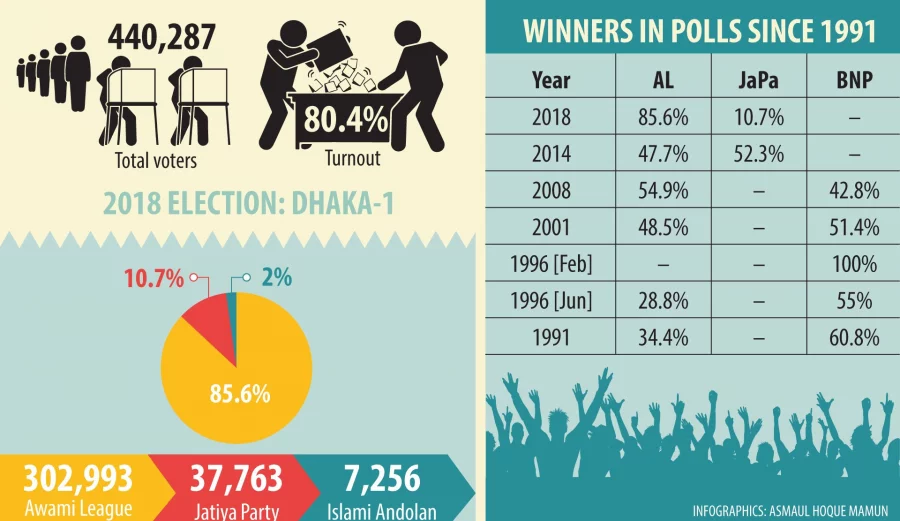
Despite this, 80.4% of eligible electors participated in the election, a significant increase compared to previous years. The total number of registered electors in the district was 440,286.
Salman received 302,993 votes (85.6%), while the previous MP, Salma Islam of the JaPa, garnered 37,763 votes (10.7%) as an independent candidate. Md Kalam Hossain of Islami Andolan Bangladesh received the third-most votes out of 7,256 (2%).
Later, the JaPa appointed Salma Islam to the reserved seat as a lawmaker.
Salman conceded defeat in the 2001 election to Nazmul Huda of the BNP by a narrow margin of 2,771 ballots.
In the mid-1990s, Salman formally entered politics by founding the Samriddhya Bangladesh Andolan (Prosperous Bangladesh Movement) political party. In 1996, he joined the Awami League as Sheikh Hasina's advisor on private sector affairs.
Salman, co-founder and vice chairman of Beximco Group, was appointed private industry and investment advisor to Prime Minister Sheikh Hasina and inducted into the party's Advisory Board in 2019. He is also a member of the Standing Committee on Public Accounts of the Parliament.
Dhaka Tribune notes a shifting political landscape in Dhaka-1. Awami League (AL), Jatiya Party (JaPa), and Bangladesh Nationalist Party (BNP) have emerged as formidable rivals, having won three, three, and five elections, respectively.
Before the twelfth national election, this comprehensive analysis analyses the eleven parliamentary election results since 1973 to identify patterns and trends in the electoral landscape of the constituency.
None of the main parties have announced their candidates as of yet, but the incumbent lawmaker and other potential candidates are demonstrating their organisational skills during ongoing political programmes.
Previous Polls
Salma Islam, running on a JaPa ticket as part of the AL-led Grand Alliance, secured 53,341 votes (52,34%) in the tenth election, which was conducted on January 5, 2014. She defeated Abdul Mannan Khan of the AL, who received 48,690 votes (47.7%).
The boycott of the election by the opposition BNP resulted in a reduced turnout of 26.9%.
Previously, Mannan Khan won the ninth general election held on December 29, 2008, which was competitive and saw an impressive voter turnout of 89.63%, indicating robust voter participation. He received 155,864 ballots (54.9%), while Abdul Mannan of the BNP bagged 121,377 votes (42.8%).
In the eighth parliamentary election, conducted on October 1, 2001, there was a close contest between BNP's Nazmul Huda and Salman F Rahman, with 78.8% of eligible voters participating.
Barrister Huda was elected for the fourth time from the BNP-led Four-Party Alliance with 48,347 votes (51.4%), narrowly defeating Salman by 2,771 ballots. Huda was made the communications minister in Khaleda Zia's cabinet.
The BNP expelled him for breaking party discipline in 2010. Five years later, he formed a new political party, Trinamool BNP. He died on February 19 of this year at the age of 80.
Moving further back, Huda won the seventh election on June 12, 1996, with 38,172 votes (55%) of the total. Md Hashem Ali of the AL, who received 20,005 votes (28.8%), was his closest rival.
This election had an impressive 80% voter turnout. In the same year, Huda also won the contentious February 15 election.
In the fifth election on February 27, 1991, Huda emerged victorious with 55,152 votes (60.8%). Md Mahbubur Rahman of the AL came in second place with 31,245 ballots (34.4%). The participation rate in this election was 60.7%.
This time, Huda was made the information minister.
Shahid Khandaker of JaPa was elected in the elections during General HM Ershad's rule on May 7, 1986, and March 3, 1988.
Earlier, BNP's Khandaker Delwar Hossain was elected in the second election held on February 18, 1979.
The first election of independent Bangladesh was held under the Awami League government on March 7, 1973. It saw a 55% turnout with the ruling party winning 293 of 300 seats. AL's Abu Muhammad Sayedur Rahman was the winner of the first election.
Predictions
Despite the fact that the BNP's influence has diminished significantly since the 2018 election and previously because of the expulsion of Barrister Huda, the party is likely to field a formidable candidate and win the seat for the sixth time.
The debacle of Khandaker Ashfaque prior to the last election had relegated the BNP to the background, but party activists have participated in street movements in the region and the capital with much enthusiasm.
However, the local BNP is divided over the recent formation of the Dohar upazila committee, and fighting has broken out between two factions commanded by Ashfaque, the current general secretary of the district BNP, and Nurul Islam, the former vice president.
On the other hand, it is probable that Salman will again receive the nomination of the ruling party.
Dohar Upazila unit President and Upazila Chairman Alamgir Hossain, Dohar Municipality Mayor Md Almas Uddin, Nababganj Upazila unit President Mizanur Rahman Bhuiyan Kismat, and General Secretary Ariful Islam Sikder are Salman's associates in the AL unit of the constituency.
He is attending party events in Dhaka and his constituency, in addition to campaigning for Bangladesh to attract foreign investments and inspire the private sector to drive the nation's economy.