More than 13 million people may become internal climate migrants in Bangladesh by 2050 due to climate change impacts that affect the agriculture sector the most, says a latest study.
It projected that one-third of agricultural GDP may be lost in the country due to climate variability and extreme events by 2050.
Without action, climate change impacts can shrink cropland by 18% in Southern Bangladesh and 6.5% nationally by 2040, according to World Bank Group's Country and Climate Development Report for Bangladesh.
The study identifies near-term policies and investment priorities that can support Bangladesh's continued progress in building resilience to the effects of climate change.
Despite significant gains in reducing the human toll from climate disasters, Bangladesh continues to face severe and increasing climate risks, and without urgent action, including further adaptation and resilience measures, the country's strong growth potential could be at risk, according to the WB report.
The report recognized Bangladesh's successful experience with locally-led climate adaptation and recommended investments in infrastructure and services to strengthen climate resilience while supporting long-term growth. It added that actions focused on improved agriculture productivity, energy, and transport efficiency can lower future emissions while improving air, soil, and water quality.
It estimates that Bangladesh can raise $12.5 billion in additional financing in the medium term for climate action. The financing options include budget prioritization, carbon taxation, external funding, and private investment.
The report, which outlines priority actions and financing needs to help Bangladesh address the climate crisis, was released during a program at a city hotel on Monday.
Citing Bangladesh as the most vulnerable to climate migration in South Asia, it says about 2.5% of the population, or 4.1 million people, were displaced due to climate disasters in 2019.
 Dhaka Tribune
“By 2050, some 13.3 million internal climate migrants and around 27% of all South Asian climate migrants in the future are projected to be from Bangladesh due to climate-induced impacts on agricultural production, water scarcity, and rising sea levels, with higher impacts on women,” the report said.
“Without targeted policy action, increasing internal climate-induced migration will impact climate-sensitive sectors and further strain infrastructure and social safety net systems in rural and urban areas alike.”
Climate change to hit poor, vulnerable hardest
 A farmer places water weeds on top of the seedlings' root on a floating bed, at his farm in Pirojpur district, Bangladesh, August 16, 2022 Reuters
Climate change will hit poor and vulnerable people the hardest.
Average tropical cyclones cost Bangladesh about $1 billion annually. By 2050, a third of agricultural GDP could be lost. In case of severe flooding, GDP could fall by as much as 9%, according to the report.
“Bangladesh has led the way in adaptation and disaster risk management. Over the past 50 years, it has reduced cyclone-related deaths 100-fold. Other countries can learn from this,” said World Bank Vice President for South Asia Martin Raiser.
“But with ever-increasing climate risks, further adaptation efforts are vital, and a low-carbon development path is critical to a resilient future for Bangladesh.”
Although Bangladesh currently contributes an insignificant amount of only 0.4% to the global greenhouse gas (GHG) emissions, the emissions will increase substantially, given its large population and fast economic growth, if the country follows a “business-as-usual” development pathway, he said.
32% of all deaths linked to environmental degradation
 Mehedi Hasan/Dhaka Tribune
Bangladesh also faces a high level of air pollution, which costs about 9% of GDP annually, said the World Bank report.
“The costs of environmental degradation and natural disasters also are expected to rise over time, compounded by higher heat and humidity and impacts on health. Thirty-two percent of all deaths in Bangladesh are linked to environmental degradation, particularly outdoor and household air pollution; inadequate water, sanitation, and hygiene standards; and lead exposure in adults,” it said.
These degradations account for a premature death rate of 169 per 100,000 inhabitants. The annual cost of such environmental health effects was estimated to be Tk4.4 trillion in 2019, equivalent to 17.3% of GDP, according to the report.
The report suggested improved air quality standards across multiple sectors to improve health and increase climate resilience.
‘Spur private sector involvement, drive innovation and efficiency'
 BIGSTOCK
Speaking at the event, IFC's acting regional vice president for Asia and the Pacific John F Gandolfo said: "In the face of multiple severe risks from climate change, Bangladesh urgently needs to spur more private sector involvement not only to deliver the billions of dollars needed for climate action, but also to drive innovation and efficiency to benefit and protect the country's people.”
He said: “Increased private sector involvement in renewable energy and energy transmission, housing, transport, and climate-smart agriculture is both necessary and possible, with concerted efforts to speed up needed reforms to overcome barriers to domestic and foreign investment and green the financial sector so more funding is available for green projects.”
Professor Saleemul Huq, director of the International Centre for Climate Change and Development (ICCCAD), emphasized the need to think differently, rethinking the reality on the ground and particularly investing in younger people.
“We need to think of how do we bring up the next generation within the next remaining years of this decade so that Bangladesh becomes a global leader, which it already is on adaptation, but it can be on development and tackling loss and damage as well,” he said.
Planning Minister MA Mannan sought cooperation from all stakeholders to deal with climate change impacts.
“It is a global issue. We will have to deal with it together. We would like to work with the World Bank and global friends to tackle this crisis,” the minister said.
Priority areas for Bangladesh
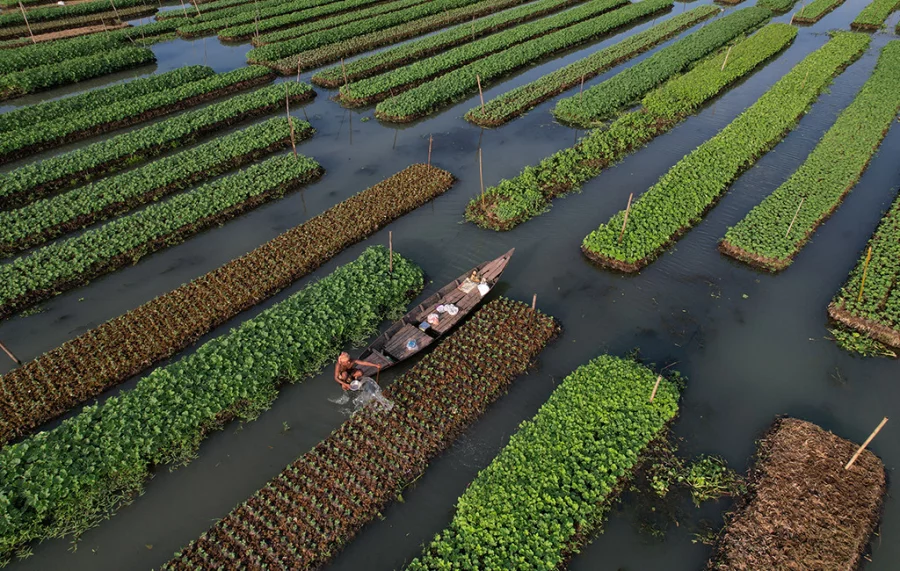 A farmer irrigates his floating bed, at his farm in Pirojpur district, Bangladesh, August 16, 2022 Reuters
The report highlighted three priority areas for Bangladesh's climate-resilient growth and development: People-centric climate-smart development, delivering development benefits with decarbonization and enabling environment and institutional realignment.
Stressing the need for a development approach considering regional variations in climate impacts and an approach that builds on Bangladesh's experience of locally-led adaptation and small-scale solutions, the World Bank said: “Investing in public services, nature-based solutions, and infrastructure in urban areas—including affordable housing, resilient transport connectivity, and water and waste management—will help cities prepare for an influx of climate migrants.”
It said that by implementing policies that abate both air pollution and emissions, Bangladesh can reduce deaths from air pollution by half or save nearly one million lives within 2030, suggesting the government shift industries to a more sustainable path to increase global competitiveness.
Suggesting empowerment of local governments to plan and implement adaptation programs, it said increased domestic and foreign private sector involvement, such as in climate-smart agriculture and renewable energy, is necessary.
It also emphasized investments for climate hotspots such as in the Barind, Coastal zone, Haor area, and Hill Tracts, and the regions facing higher poverty rates and natural hazards: the western upazilas of Mymensingh, eastern upazilas of Rangpur, and southern parts of Khulna Division.
The report suggested prioritizing and allocating financing for the most urgent projects under the Bangladesh Delta Plan 2100, transforming food systems, implementing energy-efficient and circular economy solutions in ready-made garments and textile factories, setting resilient and energy-efficient building standards, and mitigating emissions through tariff reforms and loss reduction.
Three youth projects awarded
The World Bank, at the same event, awarded the winners of the IdeaBuzz Championship, a youth competition seeking climate-smart solutions for inclusive growth in Bangladesh and participated by over 400 university students.
The first, second, and third prizes were awarded to the students of the Islamic University of Technology, Bangladesh University of Engineering and Technology (Buet), and Institute of Business Administration, University of Dhaka (IBA-DU), respectively.