The rate of Covid-19 infection in the country has been on an upward trend for the past two weeks, but the number of hospital admissions remains low.
Experts believe there are fewer patients in the hospital because people are not seeking admission until their condition worsens. Most of the patients are interested in getting treatment at home.
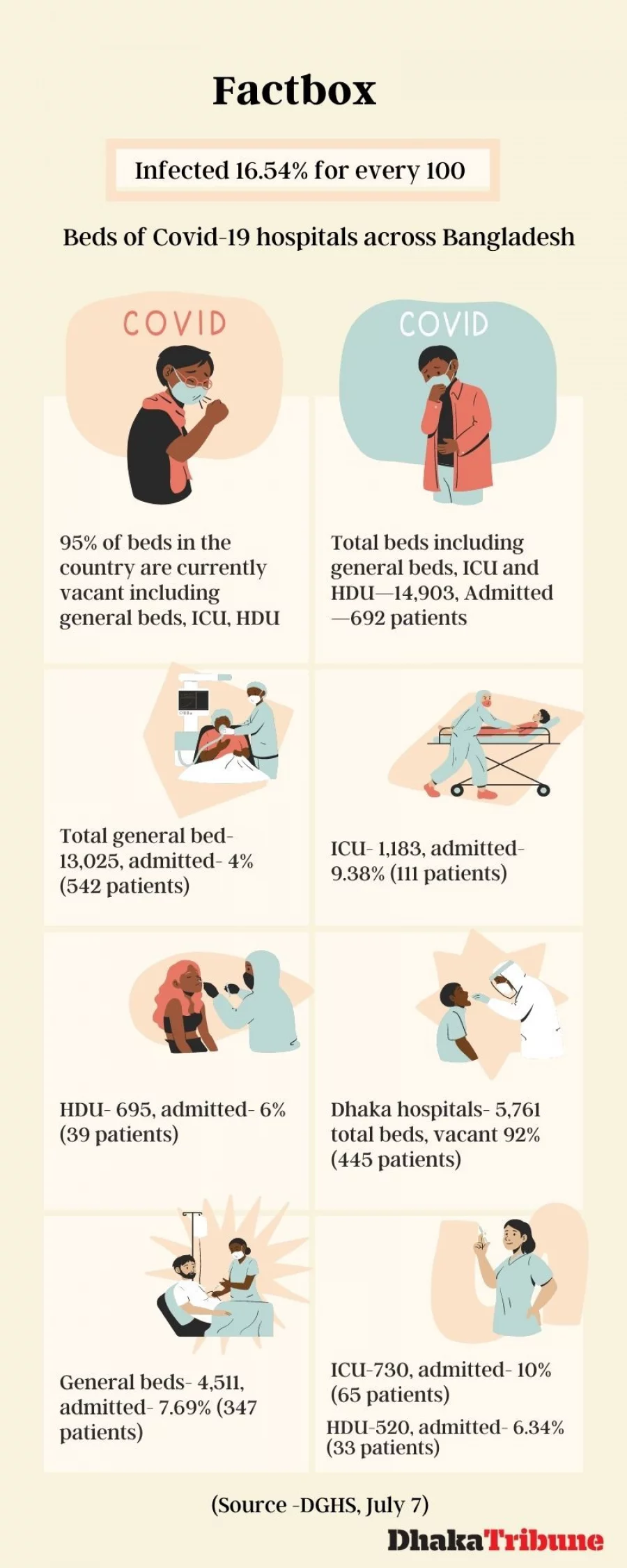
As of Thursday, when 100 people were tested for symptoms, 17 were confirmed to be Covid-19 cases. However, 95% of hospital beds were empty.
The World Health Organization (WHO) says infections have been on the rise in Bangladesh and two other countries around the world for the last three weeks.
DGHS spokesperson and Line Director Dr Robed Amin told Dhaka Tribune that many people are not paying attention to symptoms and are not getting tested. “An unidentified person infected with coronavirus is involved in spreading the virus. So, the infection rate is increasing. But the impact is felt less as the number of patients admitted to the hospital is low.”
On Thursday, three deaths from Covid-19 were recorded and 1,790 fresh cases logged at a daily infection rate of 16.54%.
Out of 14,903 beds in total, only 692 were occupied. Out of 13,025 general beds, 542 beds or 4% were occupied.
A total of 111 people were being treated at ICUs (9.38% beds occupied) and 39 at HDUs (6%).
According to the hospital admission rate, the number of ICU and HDU patients is higher.
Experts say most people buy medicines from dispensaries without testing for symptoms like fever, runny nose, cough and body aches. As a result, the actual rate of infection is not yet known.
However, the new sub-variant of Omicron type BA.4 /5 are spreading very fast. “So, the infection is higher and the crowd of people in the hospital will increase within two weeks, we think,” said Dr Mohammed Atiqur Rahman, professor of the Department of Respiratory Medicine at BSMMU.
“Covid samples are now tested at a total of 880 centres in the country. However, the number of sample tests is less than what is being heard about fever, cold and cough,” said Atiqur Rahman.
He added that nothing could be said for sure about the new subtype of the Omicron variant that is spreading. “It has individual characteristics, and spreads quickly. The effects will not be severe for all, but will work as a danger to those whose physical condition is already critical. Like, it will be a problem for those suffering from diseases like diabetes, heart, cancer and also for those suffering from various respiratory diseases.”
There were no deaths in the country from May 30 to June 19. One patient died on June 20. Since then, the death toll has been rising almost every day.
“The more it spreads, the worse the situation will be. We anticipate that the number of infections will increase after Eid and the number of patients in the hospital will also increase,” said Dr Robed Amin.
Accurate transmission information is not available due to lower number of tests. “People are going out and getting infected fast. We have made all the preparations in the hospitals to deal with this new type of variant situation. There are adequate arrangements for oxygen supply. However, people will actually have a lower mortality rate in the hospital unless their physical condition becomes critical.”
Why infection increasing again?
The health authorities have shown success in vaccinating majority people of the country. According to the WHO, Bangladesh has vaccinated 70.4% of the population with a full two-dose vaccine. In this case, Bangladesh is ahead of India, Nepal and Sri Lanka.
Although the infection has increased so far, this new type of coronavirus is not severe yet. Whether it is just the vaccination or anything else are now coming to the fore.
Dr Atiqur said: “The vaccine may not be able to prevent the virus at this time. Because the vaccine was prepared by research on the previous types. So, the vaccine is not ready to deal with new variants. In that case, the vaccine will not be able to protect us 100% from this type.”
DGHS’ Virology Department has started a new research to learn about the reasons behind the latest spike in cases.
Nazrul Islam, the head of the research team, said: “We focused on this issue towards the end of the 2021. We are analysing whether the other respiratory diseases can interfere with the growth of the coronavirus, due to which the situation is getting worse after it gets under control.”
There are two cases where respiratory diseases provide obstruction to the growth of another respiratory tract as covid-19, and it can also work to increase growth. “If we can do another analysis, we will be able to imagine the nature of the current type of the corona variant. This can be done by analysing the details of those who are dying, and those who are being infected by the new variant,” he said.