An increase in the number of people dying prematurely from exposure to polluted air is high in cities in South Asia. Among them Dhaka tops the list with 24,000 deaths in a 14-year spell, from 2005-2018.
Premature death defines deaths that occur before the average age of death within a certain population.
Altogether Bangladesh had around 25,400 premature deaths due to air pollution in 2005 and 52,400 in 2018, with Chittagong being the-second highest contributor.
Around 180,000 avoidable deaths over 14 years in fast-growing tropical cities were caused by a rapid rise in air pollution, states a study the results of which were published in Science Advances in April 2022.
The study was conducted from 2005 to 2018 in over 46 tropical cities in Asia, Africa and the Middle East. They are megacities or projected to be by 2100. From Bangladesh the researchers monitored the air quality in Dhaka and Chittagong. The researchers monitored the air quality in Dhaka and Chittagong using satellite observations.
 “We wanted to quantify long-term changes in air quality in the tropical cities which lack extensive surface monitoring to identify the real scenario of air pollution; also those which have the potential to witness even worse situations of air pollution in the coming years,” said Dr Karn Vohra, the lead author of the paper and research fellow at University College London.
PM 2.5 on significant rise due to anthropogenic activities
The international team of scientists observed significant yearly increases of fine pollutants such as nitrogen dioxide (NO2), ammonia (NH3), reactive volatile organic compounds and PM 2.5.
Across all the cities, the authors found significant annual increases in pollutants directly hazardous to health of up to 14% for NO2 and up to 8% for fine particles (PM2.5), as well as increases in precursors of PM2.5 of up to 12% for ammonia and up to 11% for reactive volatile organic compounds.
In 14 years, Dhaka had a 20.2µg/m3 increase in PM2.5, where Kolkata had the highest increase with 27.6µg/m3 PM2.5 in the region.
“PM2.5 is a very crucial particle that can be formed with various components according to the atmospheric characteristics of a particular area. The size of these particles is so minuscule that they can easily enter the respiratory system, causing mild to severe airborne diseases. In the case of Dhaka, we have seen a significant rise of PM 2.5 due to anthropogenic activities caused by the rapid growth of population,” said Vohra.
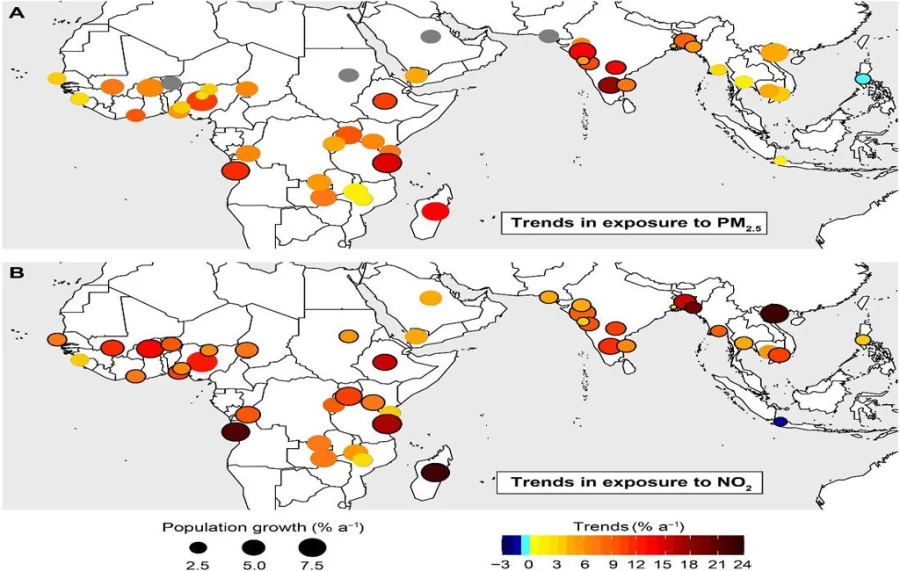
NO2 increasing at an alarming rate in Chittagong
The emission of NO2 has tripled in Chittagong whereas the change was double in case of Dhaka in 2018 compared to 2005, the report found.
The researchers attributed this increase in NO2 to emerging industries and residential sources such as road traffic. In the case of Chittagong, the rise of unregulated shipping activities at Chittagong port had a significant contribution to such an alarming rise of NO2.
At the same time the study has also seen an increase in non-methane volatile organic compounds (NMVOCs) in the atmosphere, which generally hail from activities, including construction, industrialization and burning of low quality fossil fuels.
Both NMVOCs and NO2 have a chemical relation in creating ozone production in the atmosphere. Currently, the ozone production of these two cities is sensitive to NO2, but the way these cities are growing, it’s very unlikely that the ozone will start forming by reacting with the NMVOCs by 2025 in Chittagong and by 2030 in Dhaka.
IQAir's 2021 World Air Quality Report also designated Dhaka as the second most air polluted city in the world. The report stated that Dhaka had an annual average PM 2.5 concentration of 78.1 µg/m3, whereas according to the WHO guideline the presence of PM2.5 can be not more than 5 µg/m3.