The Indian Border Security Force (BSF) has once again said it was trying to bring border killings down to zero. However, statistics have shown no sign of a downward trend in border killings over the past eight years.
On Saturday, following four days of DG-level talks between the BSF and Border Guard Bangladesh (BGB) at BGB headquarters in Dhaka, BSF Director General Rakesh Asthana claimed that the BSF used lethal weapons only as a last resort and non-lethal weapons were used first.
“Our policy is to bring border killings down to zero,” he added.
A total of 52 BSF personnel were attacked by criminals this year, according to the BSF chief.
“Criminals have no nationality. About 70% of the crimes take place between 10pm and 5:30am, which poses a challenge for us," he said.
Statistics compiled by the human rights watchdog Ain O Salish Kendra show 34 people being killed in violence near the Indo-Bangla border in the first eight months of this year. Forty-three people were killed in 2019, 14 in 2018, 18 in 2017, 31 in 2016, 46 in 2015, 33 in 2014 and 26 in 2013.
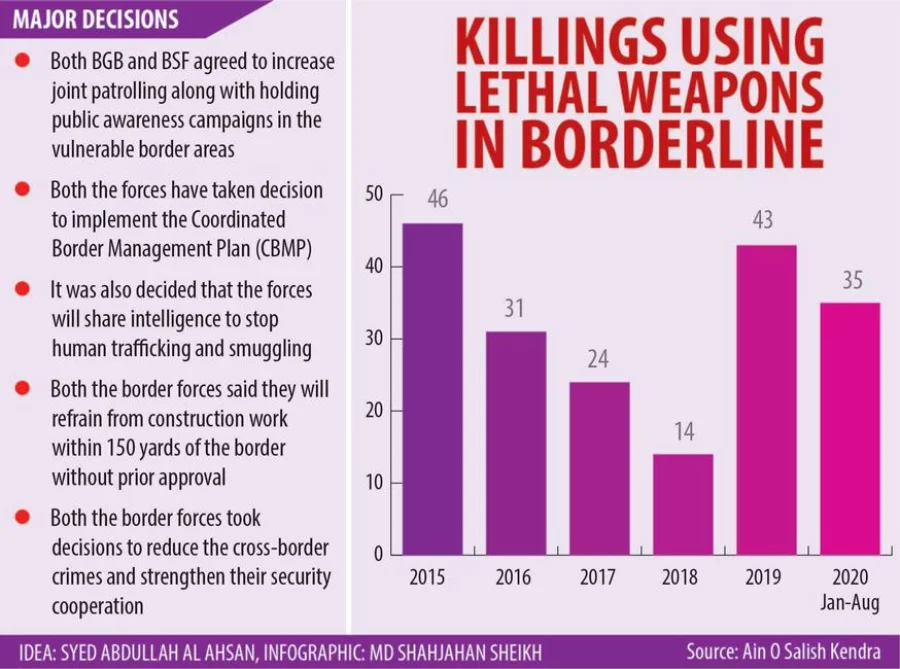
Of the 34 people who died this year, 29 were shot and five died from torture.
Section 11 (11) of the India-Bangladesh Coordinated Border Management Plan, signed by the two parties in 2011, reads: “Neither side will resort to the use of lethal weapons except in self defence against terrorists or smugglers.”
Human rights activist Nur Khan Liton recently told Dhaka Tribune that none of the people killed at the border were found to be in possession of any firearms or explosives, which meant India’s border force was killing unarmed Bangladeshis.
“No matter how many times they (India) promise to bring border deaths down to zero, their actions say otherwise,” he said, demanding that the Bangladesh government bring the issue to international attention, including taking it to the United Nations, to find a proper solution.
Promises never kept
On various occasions over the years, India has assured Bangladesh that border deaths would be brought down to zero. The BSF also promised not to use lethal weapons on the border.
This month alone, at least three Bangladeshis were killed in separate border incidents in Chapainawabganj, Thakurgaon and Kurigram.
The killings took place after Bangladesh Foreign Secretary Masud Bin Momen and his Indian counterpart Harsh Vardhan Shringla met in Dhaka in mid-August and holding out the assurance that they would focus on reducing the number of killings at the border.
According to security analyst retired Major General Abdur Rashid, India’s actions did not reflect its words.
“There can be many reasons behind border killings, but the discussions between the border guards of both countries took place to find a solution. We expect not just promises from India, but their speedy implementation,” he told Dhaka Tribune.
The BSF on many occasions had claimed that it did not shoot except as a last resort, but it was not clear what it meant by last resort, says retired Brigadier General Sakhawat Hossain.
“Are Bangladeshi people attacking BSF troops with AK-47s or heavy weapons at the border? It is illogical. Their activities quite clearly show they are following some sort of strategy upon instructions from their high-ups,” he added.
Hossain suggested that India deploy Bangla speaking BSF officials at the border, if possible, and that BSF officials face punitive action if they are found guilty of border killings.
He also urged Bangladeshis not to commit trespass at the border, as Bangladesh already had sufficiency in cattle production and there was no need for smuggling.
BSF-BGB joint patrols to curb smuggling
On Saturday, the BSF chief said India was committed to bringing cross-border narcotics smuggling to zero as well.
"We will curb smuggling along the border area with joint patrols," he said.
BGB Director General Major General Md Shafeenul Islam said both BGB and BSF had agreed in their discussions to stop border killings, since killings had a psychological impact on people.
However, he also urged the people of Bangladesh not to approach the zero line or trespass into Indian territory.
Major decisions
Regarding waste water in a cross-border canal from India making its way into bordering Akhaura upazila in Bangladesh, the BGB chief said: "This is not our issue. However, we have asked our ministries concerned to talk to their Indian counterparts about the use of water treatment plants in this manner."
Both the BGB and the BSF agreed to increase joint patrols and to hold public awareness campaigns in vulnerable border areas with the aim of bringing down killings, injuries and assaults to zero. They also decided to implement the Coordinated Border Management Plan (CBMP). Border Guard Bangladesh chief Md Shafeenul Islam and India's Border Security Force Director General Rakesh Asthana addressing the media at a joint press conference after the 4-day talks at the BGB headquarters in Dhaka on Saturday, September 19, 2020 CollectedIt was decided that the forces would share intelligence in order to stop human trafficking and smuggling of arms, narcotics, gold and counterfeit money.
The border forces chiefs expressed concern about the recent intrusion of mentally challenged individuals in the border areas. Both sides agreed to verify the nationality of such individuals and expedite the handover/receiving process with each other's cooperation.
Both the border forces said they would refrain from construction work within 150 yards of the border without prior approval.
The forces agreed to cooperate in completing all riverbank protection work in the border areas following approval from the Joint Rivers Commission.
The BSF chief said he expected continuous cooperation from Bangladesh to eliminate the possible hideouts of Indian insurgent groups, while the BGB DG assured him that there was no camp or hideout of such groups inside Bangladesh.
The BGB chief said Bangladesh did not allow her soil to be used by any entity or element that was hostile to other countries, especially India, and assured all possible help in this regard.
The top-level border conference between the BGB and the BSF began on September 16 and concluded on Saturday with the signing of a Joint Record of Discussions (JRD).
BGB chief Shafeenul Islam led a 13-member team and his BSF counterpart led a six-member delegation at the talks.
DG-level talks between the BGB and the BSF were first held in 1975. Such talks have generally been held twice a year: once in Dhaka, and once in Delhi.