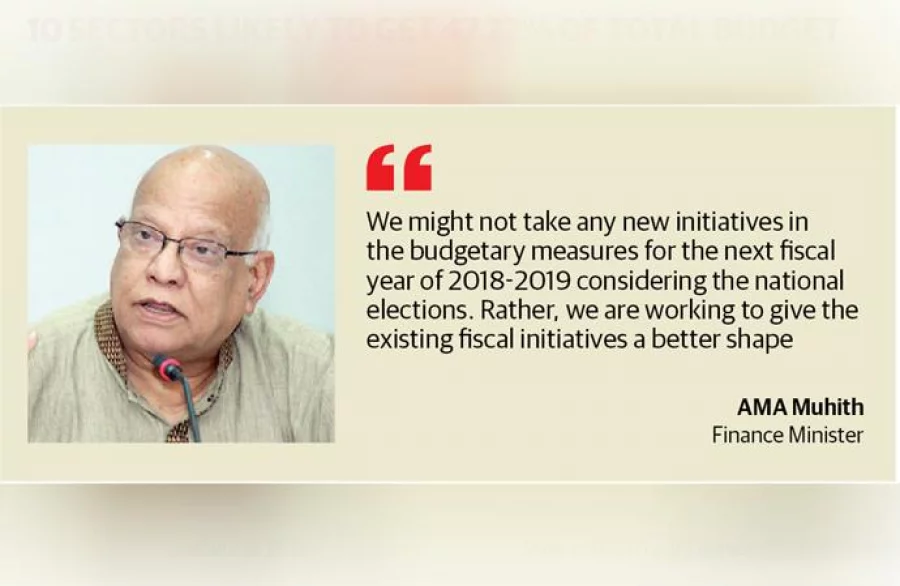
The 47th national budget, to be announced by Finance Minister AMA Muhith today, promises to offer something for everyone with an eye on the national polls scheduled for December this year.
The finance minister will place the budget for the 2018-19 fiscal year before parliament at 12:30pm.
Aiming to amaze voters ahead of the national polls, the government is planning to respond positively with long-standing demands from various quarters, according to sources at the Ministry of Finance.
From farmers to local industries – today’s budget will offer something for everyone, they said.
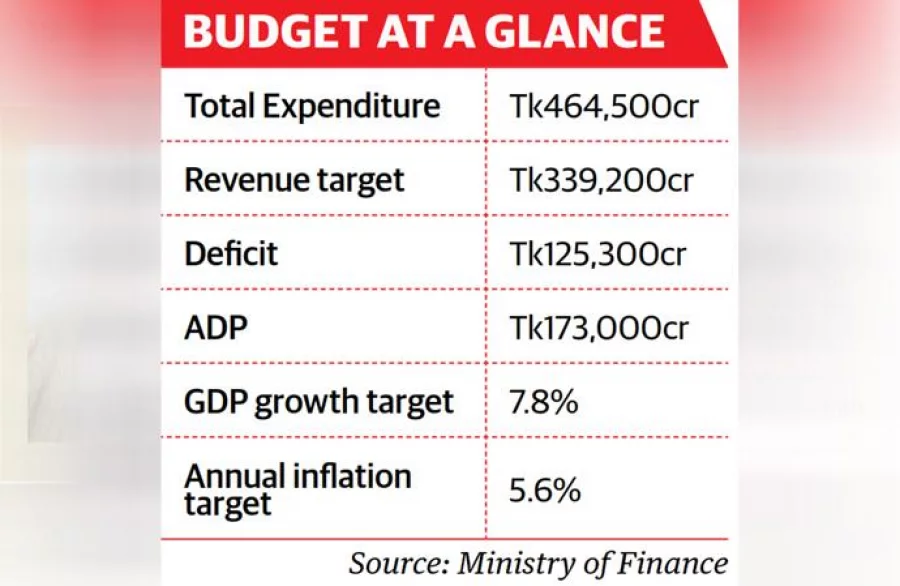
The size of the new budget is likely to be Tk464,500 crore – 16% greater than the outgoing fiscal year’s proposed budget of Tk400,266 crore.
The revenue target is expected to be set at Tk339,200 crore, which includes a tax collection target of Tk296,000 crore that the government has set for the National Board of Revenue (NBR).

The new tax collection target is 30% higher than the outgoing fiscal year’s revised collection target of Tk225,000 crore, said NBR sources.
Of the Tk296,000-crore tax target, the NBR will have to collect around Tk110,000 crore in value-added tax (VAT), Tk100,200 crore in income tax, and the rest from customs duty and other sources, said NBR officials.
The budget is expected to bring good news for the banking sector as the corporate tax for banks is likely to be cut down to 37.5% from the existing 40%.
Sources at the Finance Ministry said the total revenue collection target has been set keeping an eye on the expansion of the tax base, instead of making changes to the existing tax structure.
Ministry officials involved with the budget preparation said, in a bid to boost stagnant private sector investment, the government plans to reduce corporate tax rates and avoid double taxation on subsidies from the incoming fiscal year. Besides, there will be no taxation on any new sectors, they added.
Meanwhile, ministry sources said the government was planning to introduce a two-stage VAT rate from the next fiscal year, implement new rules to introduce an online system, adopt an Electronic Fiscal Device (EFD), and increase the tariff value of existing goods and services.
Prioritizing the election year, the government is likely to allocate 47.22% of total expenditure to 10 sectors, aiming to attract voters.
The new budget will fund a project to facilitate home loans for civil servants, while a proposal will be put in the budget to create a business-friendly environment for local traders and businessmen.
Additional financial assistance will be provided to the country’s law enforcement agencies. The government will also undertake a program to improve living standards of the rural population.
The state-owned banks are likely to yet again get a bail-out fund of Tk2,000 crore in this coming budget.
A major focus will be on the speedy implementation of “fast-track” projects, including nine mega projects such as the Rooppur Nuclear Power Plant, Padma Bridge, Padma Rail Link, Metro Rail, and the Matarbari coal power plant, with an aggregate allocation of Tk32,555 crore.
A major addition that is likely in the new budget is the framework for a universal pension system to be introduced primarily in the private sector.
According to ministry sources, to bring more people into the social safety net program, the government will increase the number of beneficiaries to 8.6 million from the existing 7.5 million.
The government will also allocate a special fund for Rohingya rehabilitation projects, which is likely to be Tk550 crore, according to a Finance Ministry official.
Internet users as well as residential flat buyers are likely to gain from the new budget as the government may slash the VAT on internet service charges and flat prices.
Around 1,000 new private educational institutions will be brought into the Monthly Payment Order (MPO) scheme, and a special allocation will be announced for the scheme in the budget.
Individual entrepreneurs or enterprises based on social media, put under the category of “Virtual Business,” will be subject to a 5% VAT, while a 20% supplementary duty will be imposed on helicopter services .