After losing their husbands in the military crackdown in Rakhine state of Myanmar in August 2017, the widowed Rohingya women sheltering in the refugee camps of Cox’s Bazar are now facing a daily struggle to support their families.
Over 700,000 Rohingya have crossed into Bangladesh after escaping the bloodshed in Myanmar’s Rakhine state, joining about 400,000 who were already living in squalid conditions inside the cramped camps of Cox’s Bazar.
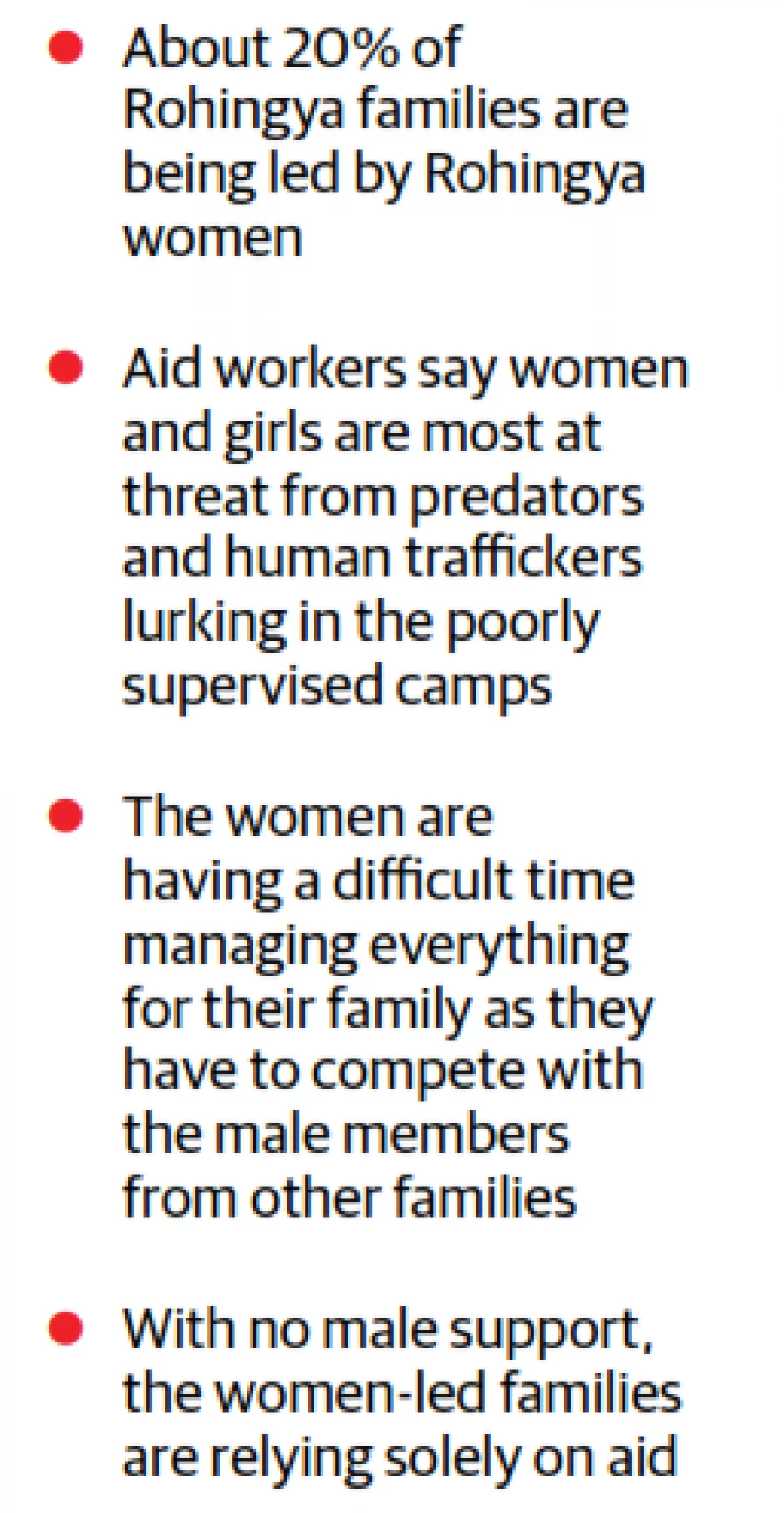
Of the latest arrivals, the UN Women agency estimates that more than half are women and children, while about one in every five families is being led by a woman.
Aid workers say these women and girls must compete against male-led families while facing the threat of human traffickers in the poorly supervised camps, as they attempt to make ends meet for their offspring and other dependents.
“We used to give money to the widows when they came here at the very beginning of the influx (and) that supported the women-led families,” Nurul Hakim, a Rohingya man engaged with a non-government organization (NGO) called Al Marazul Islamia, told the Dhaka Tribune.
“But we have not been able to provide money for last four months due to the government’s instruction.”
Despite the cutback, Al Marazul Islamia is helping to run an area of the Balukhali-2/2 camp where 27 widow-led families are living under a cluster of orange tarpaulins strung across bamboo poles.
It offers a safe haven for the families, who have been left fending for themselves after fleeing to Bangladesh.
“We are collaborating with the authorities and aid providers and taking care of the children, gate keeping their living area to ensure their security and voluntarily supporting them if they need help,” Hakim said.
Hakim said another such protected area for Rohingya widows lies within the Balukhali camp, where 48 women-led families are living.
Although these areas are off-limits to men, keeping the families safe, it is difficult for the women to maintain livelihoods without earning members in the family. They are also in need of proper food and medical treatment.
Recounting past horrors
The UN Women agency said almost every Rohingya woman and girl in the sprawling Balukhali camp has experienced or witnessed sexual assault, or seen their families being murdered or burned alive.
One such woman is Rehana Begum, 30, who found shelter at Cox’s Bazar’s Balukhali Camp-2/2 with her six children after fleeing Shikdarpara under Buthidaung Township of Rakhine state last August.
“My husband Sultan Ahmed used to hide at nearby hilly jungle in fear of Myanmar Army and their associate Moghs,” she said. “(One day) when he came home for taking a midday meal, a large number of armed soldiers and moghs cordoned our residence as well as the entire para (locality).”
Rehana said she managed to hide away with her children and other neighbours in a secret place of our house.
She said: “From there, I saw that about 10-15 armed people put my husband, along with some other male residents of the area, into a truck and took them away. Since then I do not know any trace of my husband.”
Rehana feared her husband was killed, as most of those picked up were found dead afterwards.
Chenowara Begum, a 20-year-old Rohingya woman also from Shikdarpara, told the Dhaka Tribune how she witnessed the murder of her husband, Md Emran, while hiding away with their three children.
“My husband was slaughtered right in front of my eyes,” she said. “I was in a hidden place at the house of one of my neighbours with other women. As a result, we managed to survive.”
Both widows said they have been feeling safe in Bangladesh but are facing many problems in managing their livelihoods.
Lack of support in the families
Khurshida Begum, the 18-year old daughter of another Rohingya widow, Latifa Begum, said that she and her younger sister Hamida Begum have to manage everything for their family.
Another widowed refugee, mother-of-two Asmida, and her mother Lalu Begum said they face troubles with their daily livelihoods in the camp. They called for special considerations from the authorities during ration collection, and for job opportunities to enable them to support their families.
Raiju Begum, 20, of a remote village in Maungdaw under Rakhine, said that the main problem with camp life is collecting enough food and firewood to meet their daily needs.
“We do not feel safe sending our children outside the forest area to collect firewood,” she said. “Also, we feel insecure when we go to collect food from the aid providers leaving our kids alone at the tent, as there are reportedly kids-lifters at the dense camp areas.”
Raiju Begum’s husband, Hossain Ahmad, and her brother, Md Alam, were both picked up and killed by Myanmar’s armed forces. After that, she managed to flee Maungdaw and reach Bangladesh with her two children after a two-day journey.
“We have no supportive male member in our family, so we are dependent on the food – rice and pulse - that is provided by different aid organizations,” she said.
Rajiu was cooking “Khichuri” (a food mixing rice and pulse) for their midday meal. She said her children are bored of eating the same thing for the past six months.
“They suffer from bad digestion most of the time,” Rajiu said. “We need food variety. The other families’ male members somehow managed to work at the camp areas with aid providers and collected vegetables, fish and other food items. We cannot do that.”
On November 23 last year, Dhaka and Naypyidaw signed an agreement to begin repatriating the Rohingya refugees in January this year, but this process has stalled over technical and ground-level complexities.