The Asian Americans, including Bangladeshis, are the fastest growing electorate among all racial and ethnic groups in the United States of America.
This segment, comprising over 11 million Asian American voters, accounts for 5 percent of the electorate of the country and their votes can impact the election results to a mentionable extent.
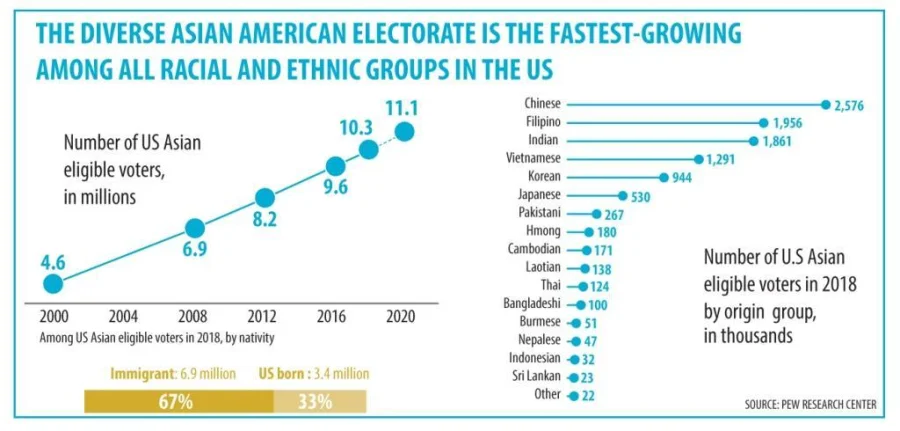
The number of Asian Americans voters was 4.6 million in 2000, Abby Budiman, research analyst (Race and ethnicity research) of the Pew Research Centre told a virtual event titled ‘2020 U.S. Presidential Election Reporting Seminar’.
The East-West Center, a non-partisan US organization, is organizing the 14-day seminar from October 25 to November 7. Twelve journalists, including this correspondent, are participating in the event from across the globe.
From 2000 to 2020, the diverse Asian American voters grew by 139%, more than Hispanic American who grew by 121%, said Budiman, adding that the black and white electorates grew far more slowly (33 per cent and 7 per cent).
Of the 11 million Asian-American, 6.9 million (67%) are immigrants while the remaining voters were born in the US, she said.
The rapid growth of the Asian American voters is mainly due to the increase of the number of naturalized citizens over the period, she said.
In terms of turnout however, White and Black American voters are far ahead than their Hispanic and Asian American counterparts, she added.
Party affiliation of Asian American voters
Chinese Americans, Filipino Americans and Indian Americans are the largest origin groups in the US Asian electorate. The Asian electorate is a diverse group, with eligible voters tracing their roots to countries in East and Southeast Asia and the Indian subcontinent. Just six origin groups – Chinese, Filipino, Indian, Vietnamese, Korean and Japanese – account for the majority of US Asian voters. This pattern closely mirrors the Asian American population as a whole: The same six origin groups make up 85% of all US Asians.
A 2018 survey by AAPI Data found that party identification varies by origin group. For example, Vietnamese Americans are more likely than Asian Americans overall to identify as Republican (42% vs. 28%). By contrast, Indian Americans are the most likely to be Democrats of any Asian origin group, with 50% identifying as Democrats and just 18% as Republican.
Asian American eligible voters are dispersed throughout the country, but more than half live in only three states – California, New York and Texas.
Meanwhile, only in Hawaii do Asian Americans account for a larger share of eligible voters than any racial or ethnic group. They make up 38% of the state’s eligible voters, by far the highest share in the country. California has the next highest share with 14%.