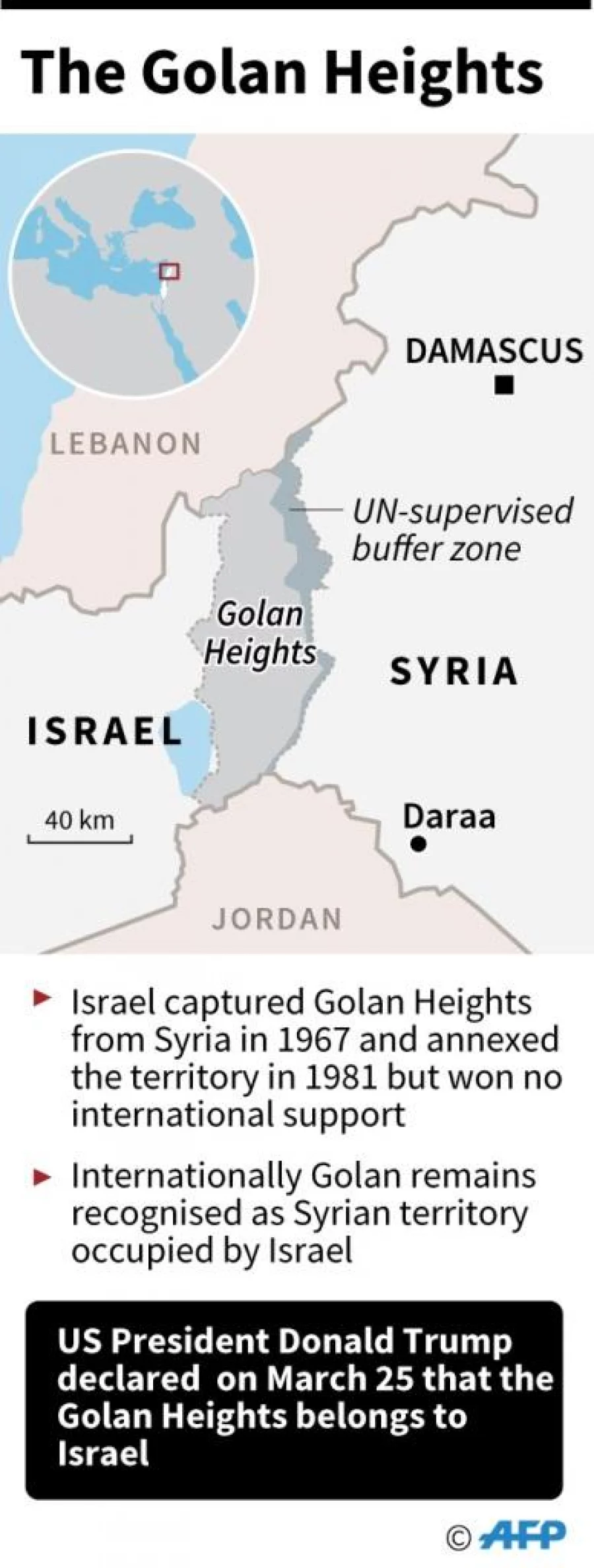
The Golan Heights, which the United States declared as Israeli territory on Monday, has long been disputed by Syria and Israel after Israel occupied the strategic plateau in 1967 before annexing the part under its control.
A vital source of water in the arid region, the Golan Heights overlooks Galilee and Lake Tiberius on the side held by Israel, which amounts to around 70% of the territory.
The armistice line with the Syrian-controlled side lies just 50km from Damascus.
Here is some background.
Occupied and annexed
Syrian forces used the Golan Heights to fire on Israel during the 1967 war, prompting the Israeli army to enter and seize 1,200sqkm of territory.
Israel occupied a further 510 square kilometres during the next war in 1973, but that was returned a year later in a deal that drew a ceasefire line and created a demilitarised buffer zone, monitored by a UN observer force.
In 1981 Israel passed a law formally annexing the occupied area.
During the Israel-Syria wars of 1967 and 1973, more than 150,000 people - most of them Syrians - fled the area.
Around 18,000 Syrians from the Druze sect - most of whom refuse to take Israeli citizenship - remain in the occupied Golan.
Around 20,000 Israeli settlers have moved in, spread over 33 mostly agriculture-based settlements.
Water
The fertile volcanic plateau, famed for its apples, is also key to the region's water supply - an important issue in stalled peace talks between Israel and Syria, which remain technically at war.
Three tributaries - the Banias, the Dan and the Hasbani - cross the highlands and help form the headwaters of the Jordan River.
The river system, which flows into the Sea of Galilee, provides about 40% of Israel's water.
Syria has demanded a return to the pre-1967 border, which would give it a foothold on the shore of Galilee and rights to the lake's waters.
Israel wants guarantees over its control of the vital water source.
Renewed tension
After a fairly quiet period, tensions flared in the Golan Heights with the start of the 2011 uprising against Syrian President Bashar al-Assad's regime.
That year, in protests marking the anniversaries of the creation of Israel and the 1967 war - in May and June respectively - Palestinian refugees living in Syria rushed the ceasefire line.
Israeli troops opened fire, killing around 30 people, according to the UN.
The area has since witnessed fierce fighting between Syrian rebels and the regime, with fire occasionally landing in occupied territory and prompting Israeli retaliation.
In 2014, 45 UN observers were held hostage for two weeks by Al-Nusra Front, then Al-Qaeda's Syrian affiliate.
Israel has occasionally clashed with the Syrian regime and with its Iran-backed ally Hezbollah in the Golan Heights.
Israel is concerned that Tehran and the Lebanese militia are embedding themselves along its frontier.
In January 2015, an Israeli strike targeted Hezbollah on the Syrian side of the demarcation line, killing Iranian soldiers, including a general.
This month, Israel's army said it had uncovered a unit created by Hezbollah across the ceasefire line in the Syrian Golan Heights, led by a commander previously jailed over an attack on US forces.
US shift
In its latest human rights report published on March 14, the United States referred to the Golan Heights as "Israeli-controlled" as opposed to "Israeli-occupied."
The wording presaged Trump's Twitter declaration a week later that Washington should recognise Israeli sovereignty.
Trump followed that up on Monday by signing a proclamation that declared the Golan belongs to Israel at the White House with Israeli Prime Minister Benjamin Netanyahu at his side.