Two Russian state institutions with close ties to Vladimir Putin funded substantial investments on Twitter and Facebook through a business associate of Jared Kushner, leaked documents reveal.
The investments were made through a Russian technology magnate, Yuri Milner, who also holds a stake in a company co-owned by Kushner, US President Donald Trump’s son-in-law and senior White House adviser.
The discovery is likely to stir concerns over Russian influence in US politics and the role played by social media in last year’s presidential election. It may also raise new questions for the social media companies and for Kushner.
Alexander Vershbow, who was a US ambassador to Russia under George W Bush and to Nato under Bill Clinton, said the Russian state institutions were frequently used as “tools for Putin’s pet political projects.”
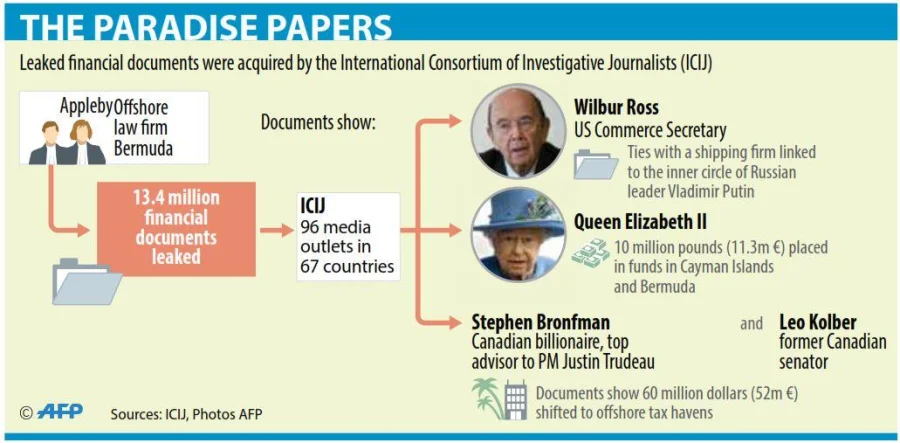
The investments are detailed in the Paradise Papers, a trove of millions of leaked documents reviewed by the Guardian, the International Consortium of Investigative Journalists (ICIJ) and other partners, along with other previously unreported filings.
Facebook and Twitter were not made aware that funding for the investments came from the state-controlled VTB Bank and a financial arm of the state oil and gas firm Gazprom, according to Milner. A spokesman for Kushner declined to comment.
The files show that in 2011, VTB funded a $191m investment in Twitter. About the same time, Gazprom Investholding financed an opaque offshore company, which in turn funded a vehicle that held $1bn-worth of Facebook shares.
The money flowed through investment vehicles controlled by Milner, who in 2015 invested in a startup in New York that Kushner co-owns with his brother. Kushner initially failed to disclose his own holding in the startup, Cadre, when he joined Trump’s White House.
Milner once advised the Russian government on technology through a presidential commission chaired by Dmitry Medvedev, the former president and current prime minister. Now based in California’s Silicon Valley, Milner has invested $7bn in more than 30 online companies including Airbnb, Spotify and the Chinese retailers Alibaba and JD.com.
Vanessa Chan, a spokeswoman for Facebook, said the investment backed by Gazprom Investholding had been sold five years ago, after Facebook went public. Chan said Facebook “rejected the notion of a lack of due diligence” being done on its investors. A Twitter spokesperson said: “As a matter of policy Twitter conducted reviews of all pre-IPO investors.”
Russian investor backed Kushner
The disclosure of Milner’s partial backing by Russian state interests may also cause difficulties for Kushner.
Milner in 2015 contributed $850,000 from his family trust to a $50m investment in Cadre, a New-York-based company that Kushner co-founded in 2014 with his brother, Joshua, and a friend of theirs from Harvard. The startup, which the Kushners claim is worth $800m, is based around an online marketplace where wealthy financiers can club together to invest in properties.
Cadre has attracted an estimated $133m of venture capital from backers including Peter Thiel, the controversial libertarian billionaire who co-founded PayPal and backed Trump’s campaign for president in 2016.
The company has already caused controversy for Kushner, after he initially failed to detail his stake in Cadre in financial disclosures to the US Office of Government Ethics. Kushner later added Cadre to revised paperwork, saying his stake in the firm was worth up to $25m.
Cadre initially said in a June press release that Milner’s stake in the company was held through his firm DST. A different version of the release on Cadre’s website said, however, that Milner himself was the investor in Cadre. The breakdown of the $50m funding was not made public by Cadre.
Milner said in an interview that he knew Joshua Kushner and had met Jared Kushner once, at a conference in Aspen, Colorado, in autumn 2016. “He was very pleasant and nice, and it was sort of a cocktail-type conversation,” said Milner, adding that politics was not discussed.