Bangladesh is one of the most vulnerable countries to the effects of climate change due to its geographical location. The adverse effects of climate change have been creating difficulties not only for the environment but also for human beings. In our country, 4.7 million people were displaced due to disasters between 2008 and 2014. According to a Unicef report, 25% of the population makes their homes in coastal areas, which are prone to cyclone damage, while 60% of the landmass is at risk of floods. Around 70% of Dhaka’s slum dwellers are environmental migrants. Furthermore, 50,000-200,000 people are displaced each year due to river erosion.
South Asia is home to more than 600 million children, and it goes without saying that the region has the world's largest youth population. Children in South Asia are experiencing increasingly alarming problems as a direct result of climate change. Impacts of climate change are currently considered to pose an “extremely high” risk to South Asian nations.
Bangladesh comes in at number 15 on the list of 163 nations examined by Uniceffor its Children's Climate Risk Index. This index evaluates how vulnerable children are to the detrimental effects of climate change. Although children, 40% of the country’s population, are absolutely not responsible for climate change or global warming, they are the ones who are going to pay the price for it in the future.
Climate change is the cause of severe weather, floods, river erosion, rising sea levels, and other environmental shocks that are affecting approximately 20 million children in Bangladesh, and one out of every three children in Bangladesh is stricken by these environmental shockwaves. It is disheartening that the futures of many of these children, in terms of both their health and their capability to receive an education, are wrecked already. Furthermore, child labour, child marriage, and child trafficking are all forms of exploitation that affect millions of children already, further compounded by a doomed future due to climate change.
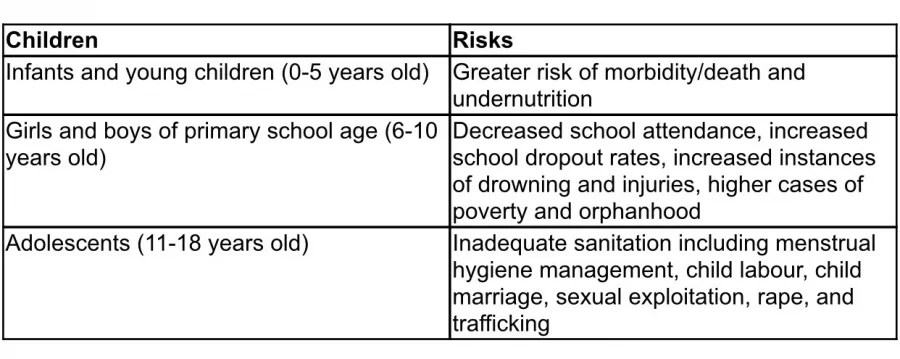
Children from different ages are facing lots of risks, which are shown to the table below:
Bangladeshi children are leaving school to work as the climate crisis surges up. According to Unicef, 1.7 million of the country’s children are now working because of families migrating due to natural catastrophes caused by climate change. Thousands of people are relocating to the slums of Dhaka owing to the more extreme weather driving severe flooding, landslides, and storms in low-lying Bangladesh. With the parents, children have to do arduous work to survive.
Studies from last year found that flooding had caused damage to over 500 different schools, causing students to be unable to attend school, halting their education in the process. The Annual Primary School Census for 2021 in Bangladesh reported that 10.24 million students were enrolled in 65,000 government primary schools. However, it was highlighted that the dropout rate in 2021 was more than 17%, with more than 2 million children opting out of schooling.
Tuomo Poutiainen, director of the International Labour Organization's (ILO) Bangladesh chapter has said children who are coerced into labour run the risk of experiencing both physical and mental harm, as well as the loss of their opportunity to receive an education. This can limit the opportunities available to these children in the future and contribute to inter-generational loops of poverty and child labour.
For climate-induced migrated families struggling with rent in slums and their daily livelihood, it is tough to manage three meals a day. Which is why their children’s education is almost always the first to be left on the cutting boardI urge national and global leaders to treat climate change as a human rights problem for children. There is a need for government-NGO collaborations and greater partnerships among the diverse stakeholders are required to develop climate-related solutions. Children’s education and health are vital issues that have been hampered by the various climatic disasters. Vulnerable families can protect themselves and their children if adequate funding, knowledge, and training are provided.
Bangladesh's institutional and national capability for anticipating and responding to climate change risks and impacts is limited. Moreover, 31.5% of the population of this country lives below the poverty line. Hence, for resources and infrastructure to be resilient in the face of climate change and other types of natural and man-made disasters, investments need to be appropriate and long-term. Policies and measures for the adaptation to climate change and the minimization of the risk of calamities need to be inclusive and participatory.
Md Obaidullah is Research Assistant, Centre for Advanced Social Research.