Skillz (NYSE: SKLZ) has not been a happy place for investors for some time now. It's true that the share price is down only - only - 68% over the last 12 months, 95% from flotation back in 2020. But it's also down some 99% from the highs reached when it was though that it might succeed in a big way. So, as we say, not a happy time for investors.
As to the why, well, one answer is that although flush with cash the company does seem to achieve much with it - the last accounts are showing a $35 million loss on $45 million of revenue. OK, that's would be fair enough in a start up perhaps but not for something that's been on the main market here for several years. One analysis of the problem is that: “The whole problem is that the game quality doesn't apparently sell itself causing Skillz to spend aggressively on marketing to acquire and retain customers. The whole premise of the investment was an appealing mobile skill-based gaming platform that should attract players with limited marketing.” There therefore has to be a massive marketing spend to get anyone onto the platform - well in excess of what is earned by getting someone onto the platform. This is not something with an obvious short term solution.
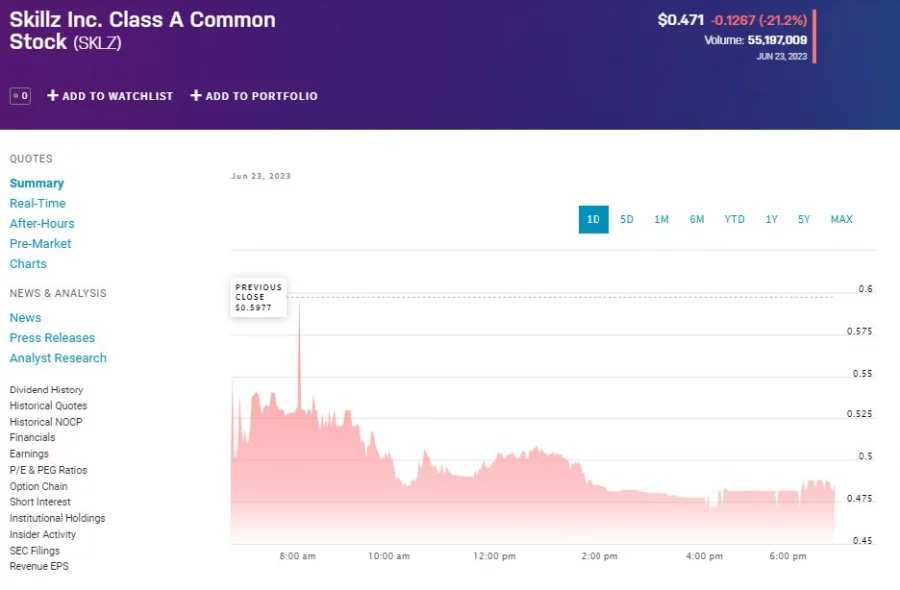
Skillz share price from NASDAQ
But dismal performance is not the only problem at Skillz. That stock price performance also runs into a problem, a cultural one on the New York markets. Penny stocks are disreputable - the sort of things that home and suffer from stock manipulators and so on. Whether that's true or not isn't the point, that's the fashionable belief. Which then means that you cannot be a penny stock and remain on one of the major - or fashionable - exchanges. Booth NASDAQ and the NYSE insist upon a $1 minimum bid price. As we can see SKLZ has fallen well below that, something must be done.
That something is a reverse stock split- simply declare that what used to be 20 shares is now merely the one - a 20 to one reverse split. This doesn't change the market capitalisation of the company, nor the value of any individual holding. It just changes the number of shares that make up each and therefore, mechanically, changes the value of each share to match.
This doesn't actually solve any of the Skillz business problems but it does at least preserve the stock market quotation while management tries to figure those out.