Rolls Royce (LON: RR.) (OTCPK: RYCEF) is really a jet engine manufacturer. Yes, we know that there are other businesses in there - modular nuclear reactors say - but the RR. business really does depend upon the jet engine business. They're among the best in the world at what they do, have huge reputation and market presence. The biggest threat to the Rolls Royce business is therefore that people stop using jet engines. We saw that during lockdown as the business suffered terribly as airlines simply stopped flying.
It's worth adding the economic model here. Yes, Rolls Royce sells the engines, but the real revenue comes from the maintenance and monitoring of those engines as they fly. Effectively RR gains revenue for each hour one of its engines is in the air. So, no flights, no such revenue.
It's possible to think there might be an extinction level event ahead. Depending upon how serious - or unserious, to taste - people get about climate change we might not be using jet engines any more. Yes, there are those other businesses inside Rolls Royce. But nothing compared to the value of that jet engine business.
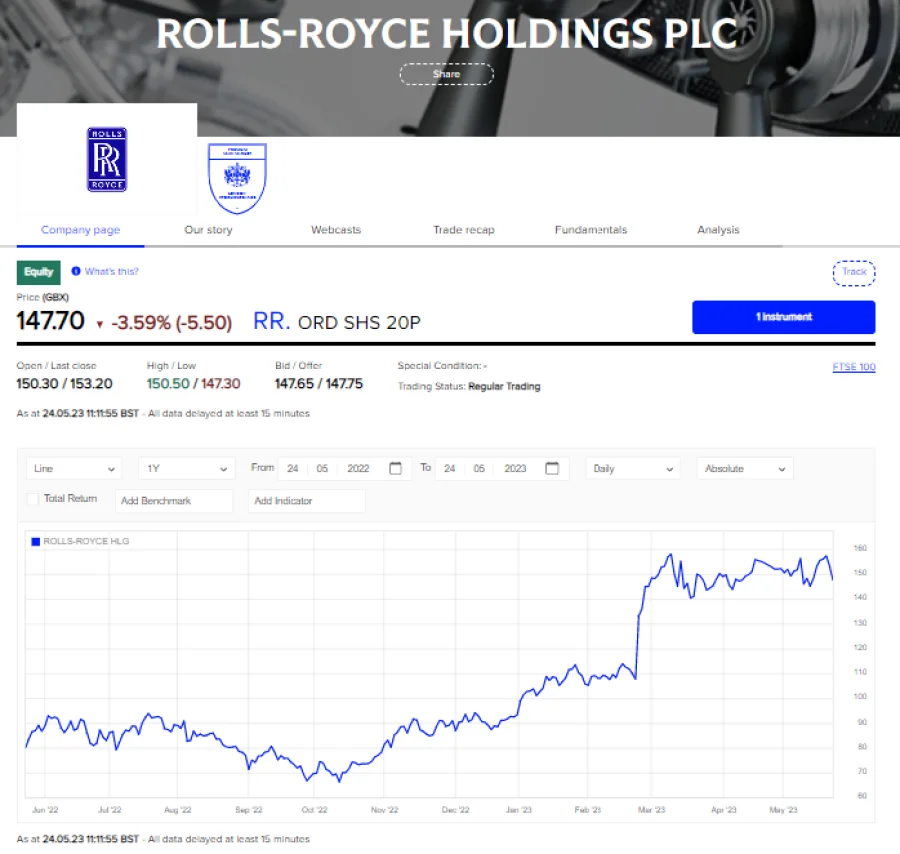
Rolls Royce share price from London Stock Exchange
As Tesla pointed out the way around this is direct air capture. Collect CO2 from the air, combine with hydrogen to make jet fuel. We now have carbon neutral flying and more importantly for Rolls Royce, carbon neutral jet engines.
But here's the puzzle, the new CEO at Rolls Royce has just cancelled that DAC programme. If this is the technology which will head off the destruction of the company then why would he do that? The answer is that there's no requirement for Rolls Royce to develop this. It's quite a long way outside their knowledge base in fact. What is necessary is that someone develops this, not that RR does. If we look around the world we can see that efuels (not biofuels, but efuels) are being developed by a number of people. It looks like they might be more expensive than standard jet fuel but only so much more expensive that we can still fly - and RR still sell jet engines.
In fact, given the engineering background at RR they aren't going to be very good at developing a DAC system. It's simply not what they do. Sure, jet engines and fuel for jet engines are linked but assuming that RR can do both is like assuming BP can make jet engines. Just not a sensible assumption.
That Rolls Royce has dropped out of trying to engineer something it's not going to be good at - as with other things - is probably a positive for the company, not a negative. As long as someone does develop economic efuels, of course.