Rain Oncology (NASDAQ: RAIN) stock fell some 87% yesterday, wiping out $300 million and change of the company's market capitalisation. The problem was that the lead candidate the company was developing turns out not, sadly, to work. This happens in this field, it's why investing in research stage pharma companies can be such a wild ride. The entire process is a series of tests, of hurdles, that must be passed. Fail at any one stage and all the previous effort - and money - has been wasted. Passing one of the tests, as Microbot Medical did yesterday, means the stock price leaps hundreds of percent. Fail one of the tests and e get this RAIN performance, near 90% of the value lost.
The specific for Rain Oncology here was that the new treatment they're trying to devise turns out not really to work. “The trial, evaluating the efficacy, safety, and tolerability of milademetan in patients with dedifferentiated (DD) liposarcoma (LPS), did not meet its primary endpoint of progression free survival (PFS) by blinded independent central review compared to the standard of care, trabectedin.” Worth noting something here. There's a rather precise meaning of “works” being used in medical trials. It means “works better than the normal treatment”. If there were no treatment at all available then something that only just worked, with lots of side effects, might be OK. But if there is already a treatment then the new attempt has to work better than the old one. Thus the way such trials are conducted - the new and the old run side by side.
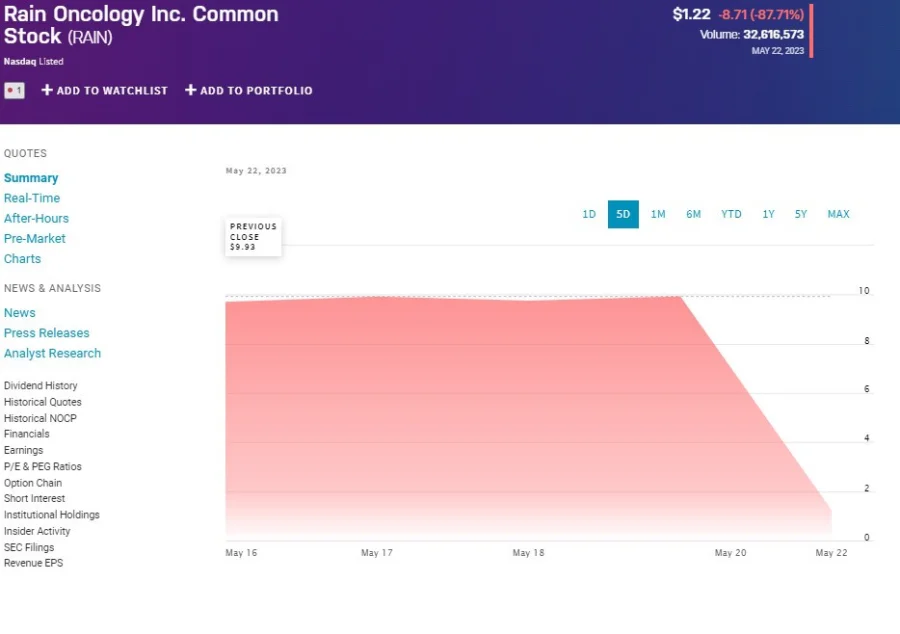
Rain Oncology stock price from NASDAQ
The reason the RAIN stock price fell so much is that the treatment, milademetan, had already passed many tests. Phase I trials, Phase II and so on. This was Phase III. So, we already had built into the RAIN stock price the value of those earlier pieces of good news. As we say, the development process is a series of hurdles that have to be cleared. Each one that is cleared adds value. Until the test that isn't passed at which point all of that value already assumed now disappears.
It is this which makes investing in pharma stocks - in development stage ones - such a wildly risky proposition. No one knows what the outcome of any particular test is going to be, that's why the test is being done. But the results of the test can double, triple, the value of the stock or, as here, can kill 90% of the valuation. The lesson from which is that yes, pharma development stocks can indeed be useful speculations. But they are speculations, to be done with modest positions and in the knowledge that they can go wildly wrong.