Caspin Resources (ASX: CPN) shares are up 15% today on the announcement of yet another rare earths find in Australia. It's turning out that rare earths are not in fact rare - something which geologists already knew but which the market wasn't quite sure about. One thing this is proving is that the rare earths problem, such as we have one, isn't about being able to mine for them. The constriction for the industry is in being able to separate them, one from the other, in a processing plant. There are currently only two of those processing plants - of any size at least - outside China.
The mineralogy here at Caspin is also entirely different from the recent ionic clay finds by the likes of Lavortto and OD6 (and, by our count, 5 other Australian companies just in the past two months). The rhyolite here is much more like the deposit at Round Top in Texas. A more difficult thing to mine but with its values all the same.
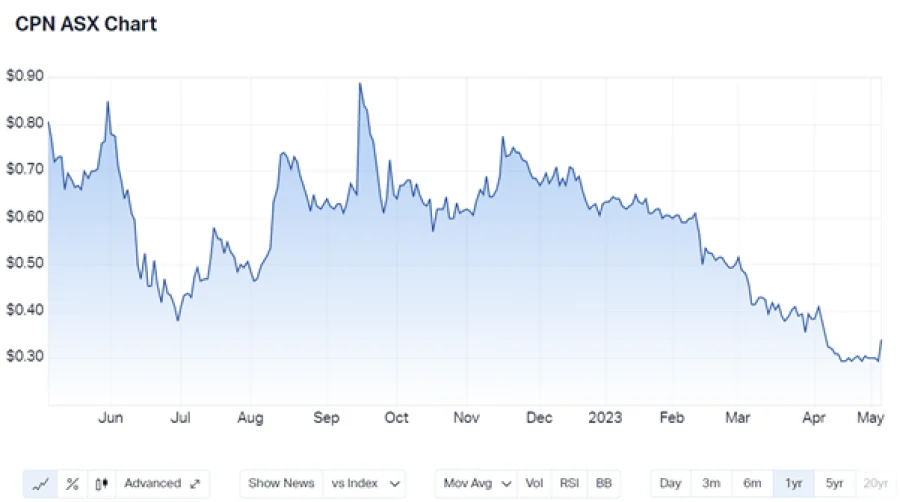
Caspin Resources share price from ASX
The details of the find are here. And it has to be emphasised that this is very early days indeed. Round Top - that similar resource - is thought of as being very rich. It's far too early to be able to say the same about this at Caspin. But the crucial point: “Significant proportion of high value light (LREE) and heavy REE (HREE) in TREO. NdPr:TREO averaging ~19%.
HREE:TREO averaging~28%. Dy2O3:TREO averaging ~2.9%, with significant contribution of Tb2O3 (both HREE)” Those are numbers much more like the results from an ionic clay deposit rather than a monazite or bastnaesite one. This means that any production gains a significant price advantage over concentrates produced from those other ores.
As we say this is all far, far, too early to be able to assign real value in the sense of this will come to production and here're some cashflow estimates. But it is, given all the usual caveats about how early this is in the proving process, an interesting find. It adds value to Caspin.
But the most interesting, on a grander scale, point to be made is that we really will have to think about renaming the rare earths - the not-very-rare earths has a tang to it, doesn't it?