Pinnacle Minerals (ASX: PIM) shares are up 30% on a couple of days, 13% down today, on the announcement of rare earth mineralisation at one of PIM's prospects. The share price is likely to remain volatile too as people try to work out what to make of the find. Matters are very preliminary and it's not entirely obvious exactly what has been found. It's still, thus, far too early to be able to say that this is an economic find, one that will progress to being mined. On the other hand, for a company the size of Pinnacle, to find something that's worth properly investigating is a victory of sorts.
The background to this is more informative though about the rare earths market in general. The tradition has been to mine for xenotime, monazite or bastnaesite - those first two often having problems with thorium contamination. The problem with all three is that they tend to be lighter in the magnet rare earths that we really want at present. That means that significant increases in those magnets will lead to considerable oversupply of cerium and lanthanum - that's just how it works.
However, we've long known about alternative deposits in ionic clays. These carry more of the magnet metals, less of the Ce and La - so we can get our magnets without that oversupply problem. Thing is, we thought until just recently that ionic clays were special to South China. We're now finding out that this isn't true, ionic clays are a commonplace - Lavortto and OD6 are only two (Pinnacle is possibly a third) of 7 companies to announce such finds just on the ASX in the past month.
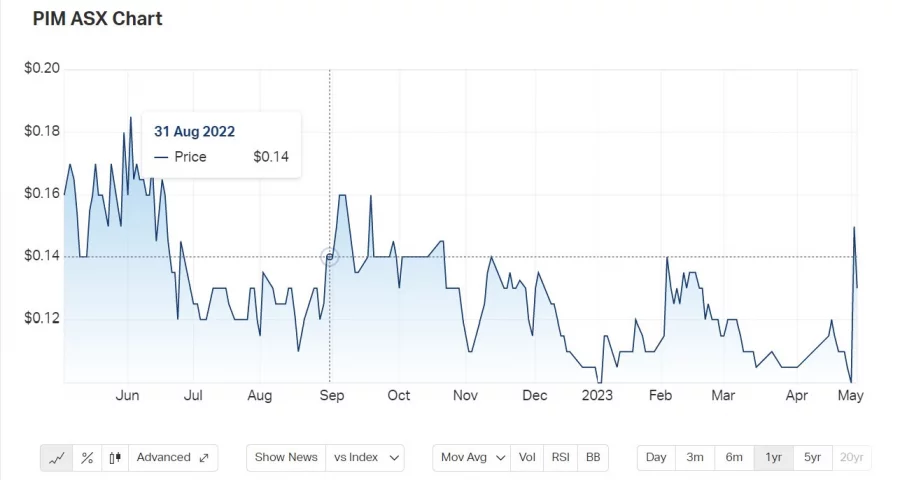
Pinnacle Minerals share price from ASX
For Pinnacle this is early days as yet: “Assays from both the clays and hard rock intercepts will be tested for the full suite of elements including REE's with the aim of determining the presence of a hard rock and/or clay hosted rare earth mineralised system.”
Very, very, early days in fact. They've found anomalous results that is, now it's necessary to test how far they extend. The thing that interests us here is that Pinnacle started out as a kaolin exploration company - China Clay effectively. And if they're finding rare earths when looking for those then perhaps others should be looking at the varied China Clay deposits to check those too? That is, we might be on the verge of finding out that rare earths really aren't rare at all.