Greentech Metals (ASX: GRE) is showing what happens at the very, very, early stages of a mining company's life. GRE is a proper tiddler, a tiny company. Market capitalisation before this rise was of the order of $2 million, $2.5 million, and that's in Aussie dollars, AUD. There's really nothing there except a bit of capital raised from shareholders and the right to look for metals in a particular area. If there are no metals there then that capital will be spent proving there isn't and that's pretty much that.
Except, of course, if there is something there. Which there seems to be. At least, something which makes looking further and harder to check it. It has to be emphasised though, for those not used to exploration stage mining companies, that this is very, very, early days. The actual announcement is: “Assays received for hole 23GTRC001 drilled at the Austin prospect reveal a copper dominant mineralised horizon with significantly increased thickness
and grades up to 5.4% Cu.” Those are good numbers for a copper ore. They're also the peak numbers, the average is considerably lower. There's some cobalt in there too. But this is the result of the one dill hole, there's much more to be done to find out whether there's actually anything worth mining there.
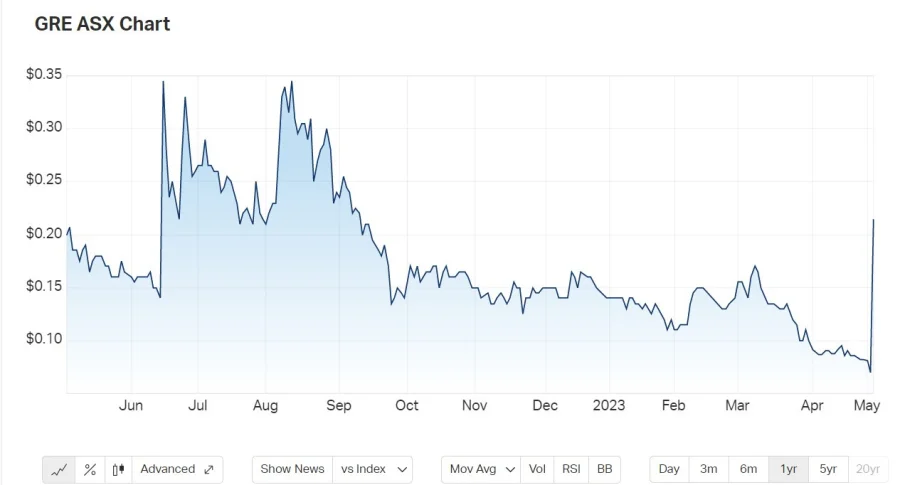
Greentech Metals share price from ASX
This is what we should think of as a validation event. All mines, all mining companies, start out as a corporate shell, some cash and an idea to look at a certain set of rocks. Then we go through varied stages of proof. Firstly, initial drilling to see whether there's anything at all. Then this second stage, confirming and possibly expanding what was first found. After this stage there's still some years of work to fully delineate the find. Then comes proof of being able to mine it, extract from it, profitability and so on. All of this work has to be funded by capital from shareholders - until there's a proven mineral reserve there there's just no asset which would provide security for any debt finance. Therefore the sequence is raise some more capital, prove the next stage in the process, the share price rises, issue more shares to fund the next stage of proof.
What makes such junior miners so risky is that it's possible to fail at any one of the stages. That means the loss of all spent so far. The reason anyone invests in junior miners is that proof of this stage's contention can mean that sort of price movement seen above. The risk reward ratio does work - but it's better to have an informed portfolio in order to spread the risks rather than attempting to find the one true goldmine.