PacWest Bancorp (NASDAQ: PACW) is the latest American bank to come under investor scrutiny. Will it go the way of First Republic and before that, Silicon Valley? The problem we've all got - and so does bank management and bank regulators - is that banking is an inherently fragile business. It relies so much on confidence and if that goes then so does the bank. Given this what matters is simply whether depositors and or investors think a bank is going to be fine. If everyone agrees with that then the bank will be fine. This, in turn, means that we've got to work out whether everyone is going to continue to believe this.
The specific and major problem at both First Republic and Silicon Valley banks was hidden in the banks' hold to maturity portfolios. The issue here is that these do not have to be marked to market. So, any losses on them - say, a result of increased interest rates in general - don't appear on the bank's P&L or balance sheet. Which is fine, they're not supposed to, as long as that portfolio doesn't get sold. But, if the depositors flee and it has to be sold then the losses get crystalised and it could wipe out the bank's capital. Which is indeed exactly what happened at SVB and probably - we're awaiting the final calculation of this - at FRC.
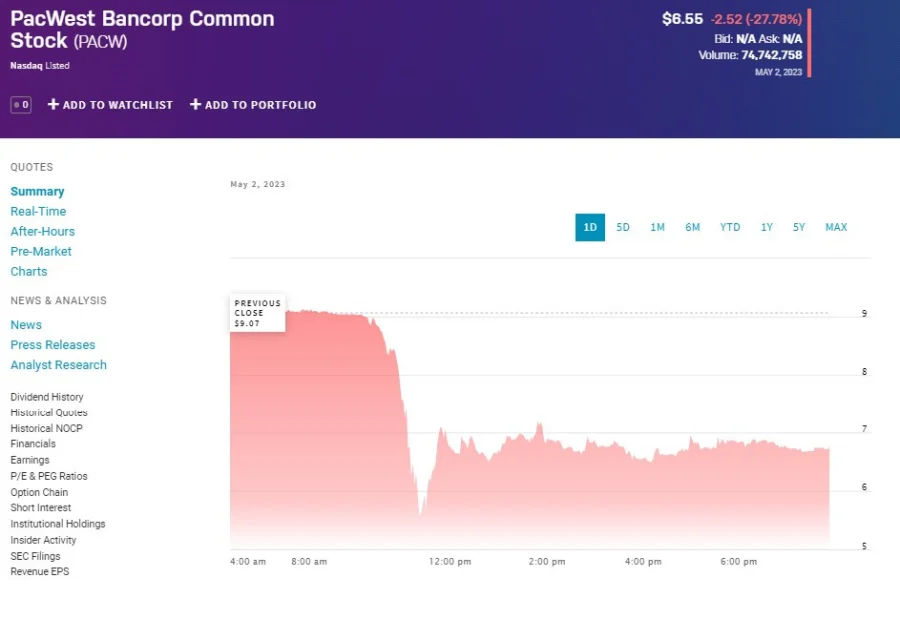
PacWest Bancorp stock price from NASDAQ
Clearly someone's worrying. But should they be so? Quite possibly not:
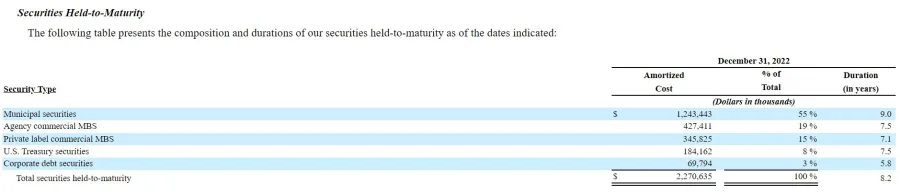
Hold to maturity portfolio from PacWest
Sure, there will be losses there. A rising interest rate environment just means there will be. But will the losses be an important and large enough issue? We'd say not. That HtM portfolio looks small enough to us (relative to total shareholder equity) that likely losses, even in the event of crystalisation, could be covered.
Note that we're not banking equity analysts so this is indeed an opinion. But our read of the numbers is that PacWest doesn't have that same specific problem. Now, whether that turns out to hold true is another matter of course…