China Overseas (HKG: 688) (OTCPK: CAOVY) shares are up 7.5% in Hong Kong on Monday. This might seem a little odd when the recent results show a decline in the dividend. That's been cut to CNY 0.40 payable in July. We don't normally expect a dividend cut to be met with a share price rise - even if the new rate is some 4.2% and comparable with other companies in the sector. The real point here though is not how much is the dividend - it's what the results tell us about the property market inside China that are.
Yes, obviously, China Overseas isn't entirely a Mainland developer, the name alone shows that. But all and any corporates in this sector will have their share prices coloured at least by opinions about how things are going in that major market. What we find from these recent results is that the dividend is well covered by both cashflow and earnings. So, in the one sense we can just say great, nice, profitable, company, why wouldn't the share price rise? The answer there being that many have been more than a little worried about the Chinese property market for some time now. So, what truly matters is how that turns out?
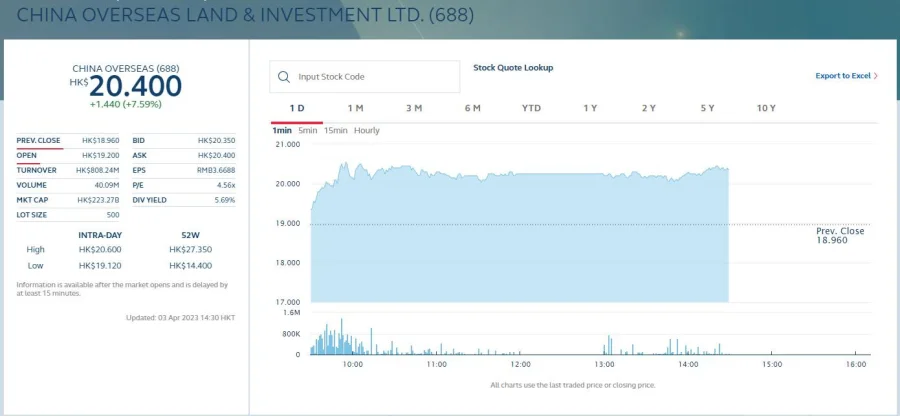
China Overseas share price from HKG
The background here is that of course China has seen phenomenal economic growth in recent decades. The fastest climb up out of poverty by the largest group of people ever. That's led to a substantial rebuilding of the country and so a booming real estate sector. The worry there is that we've seen this often enough before. Booms lead to overreach, overreach leads to a subsequent slump. So, the question is whether that is going to happen in China. For one or two companies it has already. From the results it hasn't for China Overseas.
But there's another indication we can take from this. It tends to be sectors, not specific companies, that get into trouble in a boom and bust cycle. So, if one corporation isn't suffering from market conditions then we might also assume - but note it is an assumption - that much of the rest of the sector is OK too.