Inflation has risen to 7.42% in May, the highest in eight years.
This eight year-high poses a matter of grave concern as many are struggling to pay for daily essentials such as food, rent and utilities.
The previous highest was recorded way back in May 2014, when the general inflation on a point-to-point basis was 7.48%.
This important indicator of the economy has never risen so high since then.
Food inflation in May earlier this year was 8.30%, which was 6.23% in the previous month of April.
In other words, people who spent Tk100 to buy food in May last year, had to spend Tk108.30 to buy the exact amount last month.
In the last eight years, food inflation had never been so high in any other month.
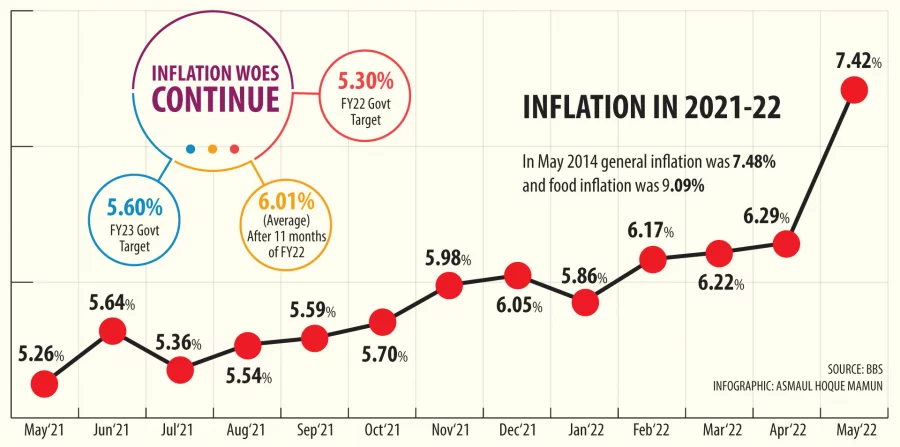
Earlier in May 2014, food inflation was 9.09%.
Last month's sharp rise in the Consumer Price Index (CPI) was more than one percentage point higher than in April, when it was 6.29%, according to latest data by the Bangladesh Bureau of Statistics (BBS).
The government has kept the average inflation rate at 5.60% for fiscal year 2022-23, which economists deemed highly "unrealistic".
They consider it so because the inflation rate for the ongoing fiscal 2021-22 was 5.30%. But after 11 months, it stood at 6.01%.
What economists are saying
Economists and other experts believe that the government missed an opportunity to contain inflationary pressure.
They suggested increasing direct taxes instead of indirect taxes to reduce the growing inequality while the tax system should be made more business-friendly to encourage investment and create jobs.
They also advised increasing the social safety net as well as to increase the interest rate of the bank by amending policies.
They also feared that if inflation went up at this speed, non-food businesses may collapse soon.
Zahid Hussain, former lead economist at the World Bank's Dhaka office, told Dhaka Tribune: “Inflation in the country's market has risen due to the rising prices in the world market, as well as the tendency of businesses to raise prices unreasonably.”
Another reason for the rising prices in rural areas is a lack of market monitoring, he also said.
Such sharp increases in rice prices during the Boro harvest month is indicative of either a production shortfall, relative to what was expected, and/or increased profiteering in the supply chain, Hussain also observed.
The slower non-food inflation in May is unlikely to be sustained as the impact of the exchange rate depreciation in May and June begin to percolate going forward, said the senior economist.
Ashikur Rahman, senior economist at the Policy Research Institute (PRI) and a member secretary of Bangladesh Economists' Forum (BEF), told Dhaka Tribune: “The issue is that while inflation is almost always extremely painful for the poor and low-income groups, business elites often oppose interest rate hikes, arguing that it will cost them more under such tight monetary scenario."
"Inflation in Pakistan is now 13% and 39% in Sri Lanka. In Indonesia, it is 3.5%, and in Vietnam, it is just 2.8%. So we can't say that prices are rising in the international market, and that is why inflation in the country has gone up. There is no opportunity to avoid responsibility by citing that as a reason," he also said.
Perhaps, the most evidence-based means to contain inflation, which has almost always worked over the last one hundred years, is to raise the interest rate, which dampens excessive demand due to additional liquidity as a result of prior monetary stimulus. Even when it has been branded as a cost-push phenomenon, excessive money supply has almost always coincided with upwards inflationary pressure, he observed.
"If we look at the international community, we will see that at least 40 countries have raised their bank interest rates to keep inflation in check. Inflation in India reached 7.8%, which began to decline after they raised bank interest rates. Basically inflation is a major headache for shrinking deposit dividends."
If one carefully monitors the monthly sales of non-essential items such as refrigerators, furniture, etc, (which should typically have an upward spike during Eid-ul-Azha) most monthly sales have dropped by 25 to 50%.
“And what is happening is not surprising. As the price of essentials shows no sign of coming down - people are cutting down on their demand for non-essential products - which is likely to have serious consequences for growth if it continues for two to three more months,” Rahman added.
Asked about the steady rise of inflation, AB Mirza Azizul Islam, economist and former financial adviser to the caretaker government, told Dhaka Tribune: “The demand for both food and non-food items in the market are increasing after the Covid-19 economic shock. Meanwhile, the value of Taka has declined against the Dollar as well. I think all these factors have been continuously affecting the inflation rate of the country for the last few months.”
According to the BBS data analysis, the price increase is hurting rural households more compared to urban consumers.
According to BBS observation, rural people are the worst victims of the CPI pressure as the point-to-point inflation rate in May was recorded at 7.94% in the countryside.
On the other hand, the inflation rate in urban areas was comparatively lower at 6.49% in the last month.
In the villages, the food inflation jumped by a record 2.20 percentage points to 8.84% in May.
However, the non-food inflation was maintaining a bit lower trend in rural Bangladesh as it declined by 0.24 percentage points to 6.26%.
In the urban areas, the month-on-month food inflation increased by 1.77 percentage points to 7.08% in May.
The non-food inflation in the cities decreased to 5.85 per cent compared to 6.25 per cent in the previous month, April.