The government should cut duties and taxes on essential commodities to ease inflation and provide relief to lower and middle-income people of the country, said the Centre for Policy Dialogue (CPD) on Tuesday.
The government should carefully examine the duty and tax structures of the commodities, both at import and domestic levels, and make necessary adjustments, the think tank also said.
Fahmida Khatun, executive director of CPD, made the remarks while presenting a keynote paper in their media briefing on the recommendations for the upcoming budget for the fiscal year 2022-23.
She also said that the high level of prices was expected to continue for the remainder of the ongoing 2021-22 fiscal year and at least the early months into the next fiscal.
“So, controlling the prices of essentials should be the most urgent and critically important macroeconomic policy objective in Bangladesh,” she added.
The think tank further suggested reducing import tariffs, value-added taxes and other taxes to reduce prices.
Moreover, the CPD also recommended increasing the tax-free income threshold to Tk3.5 lakh for the next fiscal year, considering the added pressure of rising food inflation and income erosion induced by the Covid-19 pandemic.
They also suggested the government extend the scope of direct cash incentives programs for low-income population groups and increase the sale of essential commodities through open market sales (OMS).
She said that the budget for FY23 must break free from its formulaic mould and should be adjusted accordingly to tackle the pressure emanating from both domestic and external fronts.
Proposal to change the tax structure
In the FY22 budget, corporate income tax (CIT) has been decreased for publicly traded companies (22.5% from 25%), non-publicly traded companies (30% from 32.5%), one-person companies (25% from 32.5%), and association of persons (30% from 32.5%).
However, to ensure uniformity, the tax rate for one-person companies should be set at 30%, in line with the non-publicly traded companies’ rates.
There should be a medium-term plan and timeline as regards phasing out the various tax exemptions provided in view of the pandemic. Particularly the large industries should be brought under a planned phasing out process, proposed CPD.
In order to increase the number of actual taxpayers, the NBR, using their e-TIN database, should identify and pursue individuals and business entities that are registered in the system but do not submit tax returns and who are registered and submit returns but do not effectively pay taxes.
Moreover, the NBR should launch a comprehensive online payment system for VAT, income tax and customs together with an interface with iBAS++ and ensure harmonization and taxpayer data sharing across various wings of the NBR as has been envisaged in the PFM Action Plan 2018-23 at the earliest.
Moreover, tax evasion should be curbed by all means to generate resources for the priority sectors.
In view of Bangladesh’s LDC graduation in 2026, the NBR needs to urgently conceptualize and implement a medium-term strategy
SSNP
Priority for public expenditure should be set clearly. The Covid-19 recovery and rising prices of essentials should guide the design of the fiscal framework.
To this end, food production, social safety net programmes (SSNPs)-- (including the public works programs), subsidies for agriculture, energy and power sectors, and health and education sectors should receive adequate attention.
The current structure and composition of the social safety net programs are not adequate in view of the government’s policies and pledges.
During FY2022 total allocation for social safety net programs was Tk1,07,614 crore which was 17.8% of the total budget and 3.1% of the GDP.
It is to be noted that pension for government employees accounts for 67.3% of the total allowances and 24.9% of the total SSNPs.
Government should bring the 143 SSNPs under a single, consolidated and integrated umbrella in order to move from social safety network to social security.
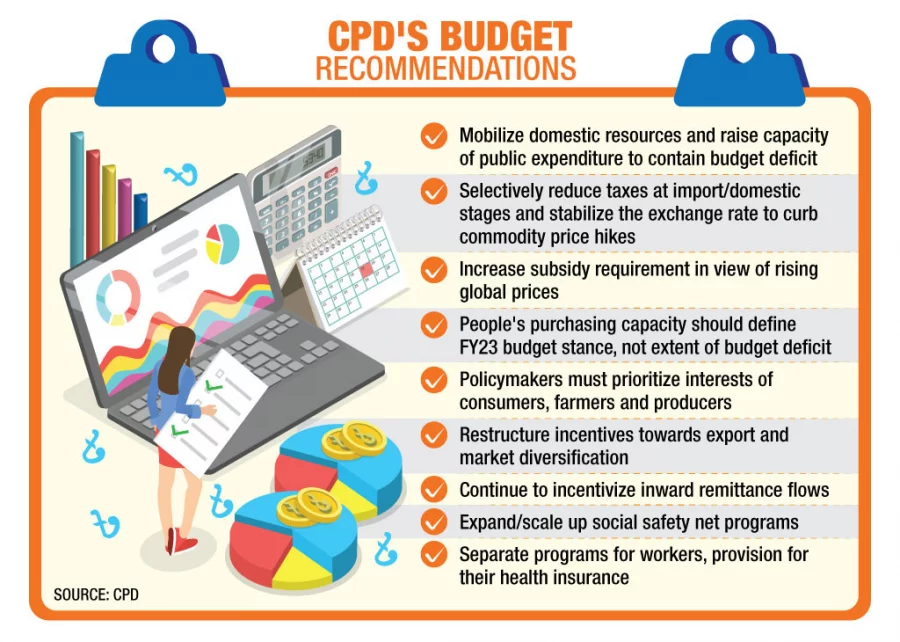
In order to contain the budget deficit, CPD has proposed measures to enhance domestic resource mobilization and raise both capacity and efficacy of public expenditure.
Subsidy Issue
Over the years, the total subsidy budget has been on the rise, from Tk13,924 crore in FY2016 to Tk49,330 crore in FY21–an increase of 50.8% per year.
Allocation of subsidies for the agriculture sector needs to be increased, particularly for accommodating the higher import price.
The budget for FY23 should be informed by the current and anticipated fertilizer price in the global market and strengthen market monitoring to ensure access to inputs at a subsidized price.
Moreover, maintain the current level of subsidy on remittances and allocate more resources to food subsidies.
CPD also suggested phasing out fossil-fuel based energy gradually.
More suggestions
CPD has also suggested diversifying the export products to increase revenue.
Moreover, the CPD thinks that the rate of inflation is not accurate and urged to calculate the inflation in the light of reality.
At the same time, syndication, hoarding by middlemen and extortion are some of the reasons for the rise in commodity prices.
The think tank has suggested strengthening the Competition Commission to control the market.
It also said that giving black money a chance to be laundered was unethical and could not be supported in any way.
Targeted investment in institutional strengthening, inter-agency coordination and interoperability of systems for digital interface, and adequate resource allocation for human resource building will be required.
The interests of consumers, farmers and producers should remain the major concern of policymakers.
CPD has proposed a separate program for workers including provision for comprehensive health insurance.
No project on political considerations
In response to a question, Professor Mustafizur Rahman, a distinguished fellow of the CPD said that there is a tendency to give political priority to development projects in ADP before the election.
“As a result, development benefits do not match. We have to be careful about this. We have to take such projects so that economic considerations prevail. The project should be given priority not for public satisfaction but for economic reasons,” he added.
CPD senior research director Khondaker Golam Moazzem proposed to increase good governance and monitoring of capital market development.
CPD senior research fellow Towfiqul Islam Khan thinks that revenue collection should be done on the basis of fairness and not on the basis of goals.