Last October saw the highest number of savings certificates cashed in a single month. Furthermore, this continuity persisted for the entire first quarter of this year.
Data analysis showed that, in contrast to the period from July to October of the previous fiscal year, when the government was able to borrow Tk9,325 crore from this sector and use it for development purposes, in the same period of the current fiscal year the government spent or paid Tk963.16 crore as interest and principal.
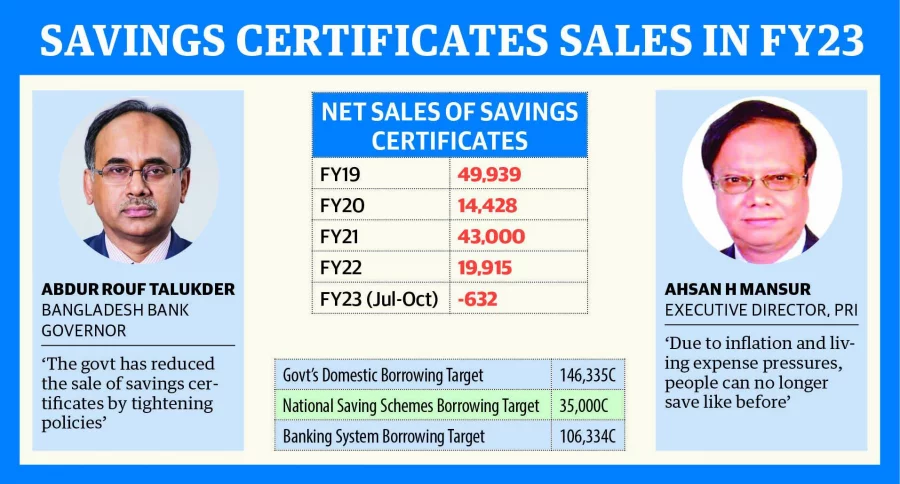
This indicates that the government's net borrowing from savings certificates has reduced by around Tk 10,000 crore when compared to the same period of the previous fiscal year.
The total amount deposited against savings certificates during the month of October of last year was Tk6,533 crore, according to a report from the National Savings Directorate (NSD) and Tk7,496 crore is the principal payment.
The net investment is to be found after deducting the principal from the total deposit.
So in the month of October, the principal payment was more than the total deposit or net investment was negative by Tk963.16 crore.
In other words, Tk963.16 crore more than the total amount of savings bonds sold during the month has been redeemed.
In October FY23 savings certificates worth Tk963 crore were redeemed while in FY22 worth Tk766 crore were purchased.
Data analysis also shows that the net investment in savings certificates has fallen to a negative trend in the first four months of the current financial year.
During these four months, the total deposits in banks, savings bureaus and post offices are Tk28,045 crore.
Against this, the principal payment stands at Tk28,677 crore.
The principal repayment is Tk632 crore more than the total deposit.
However, the net investment in the same period of the last fiscal year was Tk9,325 crore.
That means that compared to the same period of the last fiscal year, the net sales of savings certificates dropped by Tk9,957.63 crore.
The lack of investment in saving certificates means that the government does not have to borrow much from this sector.
However, the target by the government for domestic borrowing for FY23 has been set at Tk1,46,335 crore in the national budget.
Despite the dwindling sales of savings instruments, the government has set a target to borrow Tk35,000 crore from the sector in the current fiscal year.
The proceeds from the sale are deposited in the government treasury and used by the government to implement state development.
In return, the savings certificate customers have to pay profits every month.
In economic terms, the net sale of savings certificates is considered a loan or government's internal borrowing.
Regarding the continuous decline in saving certificates sales, Abdur Rouf Talukder, governor of Bangladesh Bank previously said that the government has reduced the sale of savings certificates by tightening policies.
The government is instead relying on the banking system which is considered relatively convenient for loans because bank loans are cheaper currently.
However, economists think that due to rising prices of commodities and decrease in income, people are not able to make new savings to meet the cost of living. Rather, people are meeting expenses by using previous savings.
Ahsan H Mansur, executive director of the Policy Research Institute of Bangladesh, told the Dhaka Tribune: “People have less money in hand. Due to inflation and living expenses, people are no longer able to save as before.”
Although the government agencies are seeing the decrease in the sale of savings certificates as a blessing, this former IMF economist thinks that because of this the domestic borrowing pressure of the government on the banking sector is rising too much.
“Due to the rising living cost, people are no longer able to save as before. Due to these reasons, the government is borrowing money from banks with less debt from savings certificates. However, in this case, the government has to take more loans from Bangladesh Bank as commercial banks do not have such capital,” he added.