Major Japanese readymade garment (RMG) manufacturers are shifting most of their overseas production from China as rising labour costs and zero-Covid policy is eating away its dominance.
Moreover, amid a depreciating Yen and rising costs of raw materials, apparel companies are using every available method to lower costs, according to the recent reports from Nikkei Asia and other East Asian media outlets.
Major Japanese apparel companies like Adastria, Aoyama Trading, and suppliers of Uniqlo are moving some of their production bases to Vietnam and Cambodia to take advantage of reductions in or exemptions from textile import tariffs.
Adastria, parent company of Global Work, has increased production in Cambodia and Vietnam this year.
Moreover, the company plans to expand production areas to include Indonesia, Bangladesh and other countries.
Of the company's clothing imported into Japan, the number of items produced in China fell to 59% in 2021, down from 81% a decade earlier.
Matsuoka Corporation, a contract manufacturer for Uniqlo subsidiary Fast Retailing, produced 50% of its clothing in China in the fiscal year ending in March 2022, but plans to decrease that to 29% by FY25.
Over the same period, it will increase production in Bangladesh from 28% to 34% and from 16% to 28% in Vietnam.
The company is also increasing production capacity in the two countries.
Labour cost is the biggest production cost besides raw materials.
According to the Japan External Trade Organization (Jetro), the average monthly salary of a factory worker in Guangzhou, China, recently reached about $670, which is approximately $270 in Vietnam's Ho Chi Minh City, and $120 in Dhaka, Bangladesh.
In addition, China's zero-Covid policy of initiating massive lockdowns to prevent the coronavirus spread has deeply impacted the country's production and logistics.
Japan's apparel makers have found it challenging to keep up with demand, highlighting the risk of concentrating production in China.
How Bangladesh can take advantage of this
According to Bangladeshi apparel manufacturers, they have identified several potential export markets with their own study, notable among them are Japan, Korea, India, the Middle East and Africa.
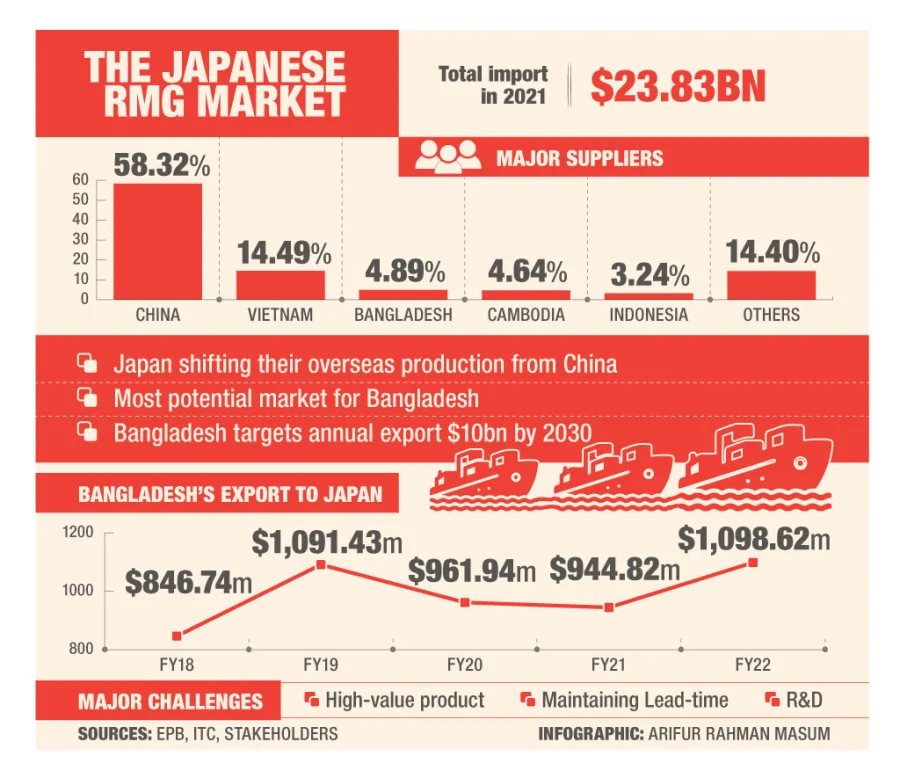
Among them, Japan is the highly potential market from where Bangladesh bagged export earnings of worth $1.09 billion in FY22 and set a target of doubling it by FY23.
A number of Japanese apparel retailers including Fast Retailing (parent company of Uniqlo and other five retailers), Adastria, GU, Muji source millions of pieces of products from nearly 300-350 Bangladeshi factories where Pacific Jeans, Urmi Group, Envoy Textiles are big names.
Pacific Jeans is Uniqlo's one of the top sources who export million pieces to the East Asian destination.
Envoy Textiles Ltd is also a supplier of Uniqlo.
Kutubuddin Ahmed, its founder, said that Japanese buyers are very careful about quality.
Talking to Dhaka Tribune, Shahidullah Azim, vice-president of the Bangladesh Garment Manufacturers and Exporters Association (BGMEA), said that Japan shifting its production from China is very good news for them.
“However, demand for high-value products is high in Japan. To capture the Japanese market we have to focus on manufacturing value-added products,” he added.
He also said that if they can do this, the country's exports to Japan may reach $10 billion every year from 2030.
He also said that China is gradually phasing out of the textile sector, which is why this sector is slowly phasing out subsidizing in China and the cost of labour is quite high there.
Mohiuddin Rubel, additional managing director of Denim Expert Limited and a director of the BGMEA, also echoed similar sentiments, adding that Japan is one of the non-traditional markets for Bangladesh with high potential.
“Uniqlo and other brands source a bulk from Bangladesh. We want to grab more share in the Japanese market and we have the capacity,” he said, adding that their FOB value was very good and they had good paying capacity.
There are some challenges also including huge investment in research and development (R&D), maintaining shipment time and capturing the fast-changing fashion trends of Japan.
“To capture the market, we must focus on high-value products,” he added.
According to the International Trade Center (ITC) data, Japanese apparel imports stood at $23.83 billion in 2021 where China's share was 58.32%, followed by Vietnam (14.49%) and Bangladesh 4.89%.
Bangladesh exported apparel items to Japan worth $1.09 billion in FY22 and in the first four months of FY23 (Jul-Oct), Bangladesh bagged $545.42 million from Japan, according to the EPB data.