The government saving certificates borrowing fell significantly in the July-September quarter (Q1) of FY23 as a result of low sales and hefty repayments.
According to the most recent data from Bangladesh Bank, the government's net borrowing from the sale of savings certificates was Tk330 crore in Q1 FY23 compared to Tk8,558 crore in the same period of FY22.
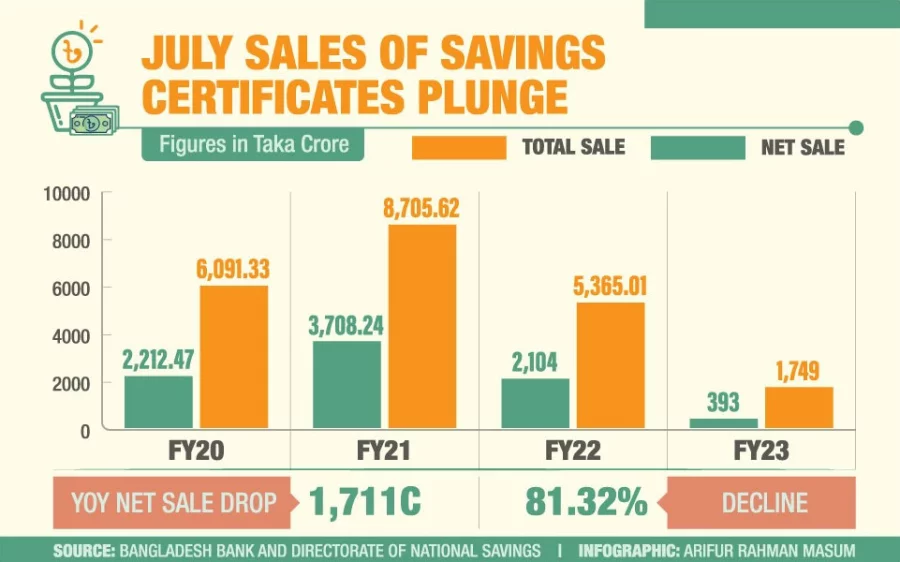
That indicates a decrease in government borrowing from this sector of more than Tk8,228 crore from the same time last year.
The government borrowed Tk21,511 crore from savings certificates in the first three months of the current fiscal and repaid Tk21,180 crore in prior loans, according to the central bank data.
Whereas in the last fiscal year 2021-22, the government took a loan of Tk26,605 crores from savings certificates and paid back Tk18,047 crore.
However, what is left over after paying the interest and principal of the savings certificate sold earlier is called the net sale of savings certificates.
The proceeds from the sale are deposited in the government treasury and used by the government to implement state development.
In return, the savings certificate customers have to pay profits every month.
In economic terms, the net sale of savings certificates is considered a loan or government's internal borrowing.
Did inflation hit hard?
According to economists and bankers, rising inflation has caused people's expenses to rise while the overall trend in savings, including savings certificates and bank deposits, has fallen.
Asked about the collapse in the sale of savings certificates and its impact, Ahsan H Mansur, executive director of the Policy Research Institute of Bangladesh, told Dhaka Tribune earlier that it is a good sign that the government's net borrowing from savings certificates is falling as it has to pay high interest and it would be better if the government takes loans from banks at lower interest.
The rate at which inflation in the country is increasing has increased the consumption of the middle class and reduced the amount of savings, he added.
Earlier, people used to buy savings certificates by resorting to forgery which is regulated now.
It too has contributed a lesser amount of credit to the government, said Ahsan Mansur.
Data analysis shows that, at the end of August, the deposits of the bank sector increased by only 7.53% to Tk14.68 lakh crore.
At the same time, private sector credit growth surged to 14.07%.
The ceiling on bank loan interest rates of 9% has not increased despite the rise in inflation.
That is why there hasn't been an increase in the average interest rate on bank deposits.
The average interest rate on deposits in August of last year was 4.07%, according to data from the Bangladesh Bank. But in August and September, the inflation rates were, respectively, 9.52% and 9.10%.
IMF want a further reduction
Sources claim that the IMF team shared their opinions and inquired about several aspects of savings certificates during a meeting.
Additionally, they were interested in the government's position on these savings.
The IMF wants Bangladesh to further reduce the interest rate on savings certificates and keep the rate at least close to the market rate.
On September 22, 2021, just 13 months earlier it was rescheduled and now three tiers are in operation.
Accordingly, investors with less money are getting more interest, and investors with more money are getting less interest.
But still, the IMF says the current rate is higher than the market rate.
The Finance Division has informed the IMF that the interest paid against investments of more than k30 lakh is almost equal to the market rate.
And in less than a year three different interest rates have been set.
The interest rate on savings bonds is subsidized by the government and is also considered by the government to be covered by the social safety net sector, the IMF was told.
Earlier, on May 23, 2015, the government reduced the interest rate of all types of savings certificates by an average of 2%.
Government's borrowing target
However, the target by the government for domestic borrowing for FY23 has been set at Tk1,46,335 crore in the national budget.
Of the total, in FY23 borrowing target from the National Saving Schemes set at Tk35,000 crore.
On the other hand, the target of borrowing from the banking system has been set at Tk1,06,334 crore.
Meanwhile, the government's borrowing from the central bank has increased, but the repayment is more than the borrowing from the scheduled banks.
According to central bank sources, in the first quarter of the ongoing FY23, the government borrowed a net loan of Tk12,526 crore from the banking system, which was Tk4,218 crore in the same period of the previous fiscal year.
At the same time, the government has borrowed Tk16,833 crore from the central bank in the current year.