Deposits have not only decreased in rural areas of Bangladesh but many savings accounts have been emptied because of inflation.
Bangladesh Banks' quarterly Scheduled Banks Statistics and their monthly inflation data were published by the Bangladesh Bureau of Statistics (BBS).
The data revealed this trend is rising quite fast in rural areas.
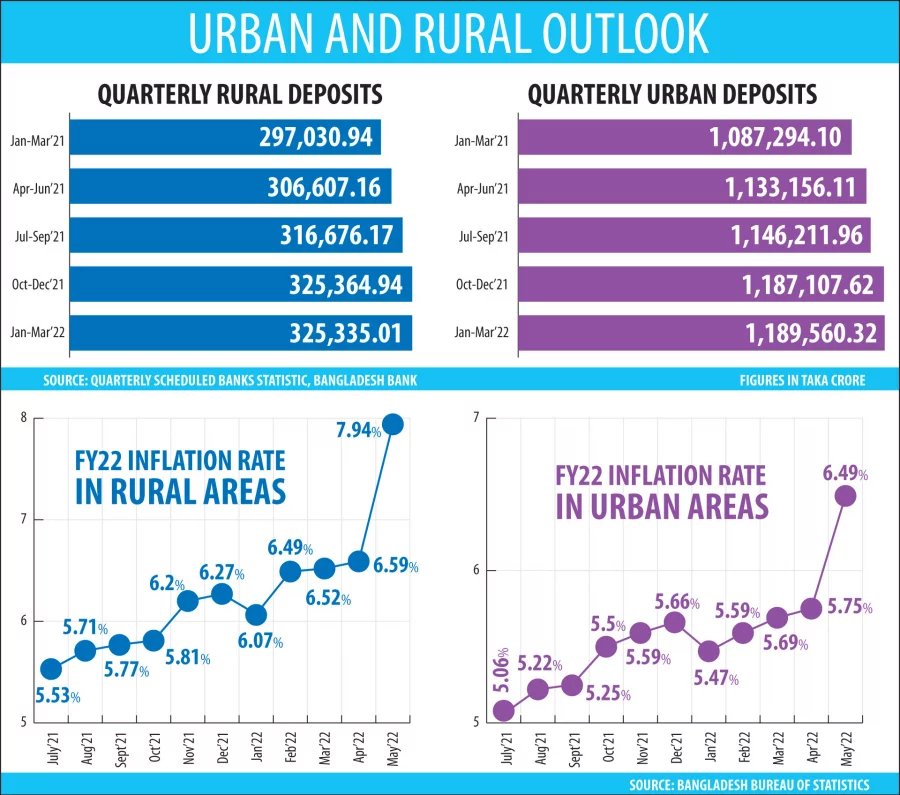
According to Bangladesh Bank’s scheduled bank statistics at the end of the first quarter (Q1), deposits in rural areas decreased by Tk30 crore at an average of Tk10 crore per month.
On the other hand, in May when inflation rose to 7.42%, the highest in eight years, rural areas saw inflation of almost 8% whereas it was 6.49% in urban areas.
Economists said the impact of inflation on the underprivileged, especially in rural areas, is growing at a much higher rate than in urban areas.
To help them come with this, economists also urged banks to increase or reschedule the bank deposit rate.
Bank deposits in Q1
By the end of March, the country's total bank deposits had increased to about Tk15,14,895.33 crore which was Tk15,12,472.56 crore in the previous October-December quarter.
Data shows during this three-month period, bank deposits decreased by Tk29.93 crore in rural areas.
This means that the average deposit in the country's scheduled banks in rural areas has decreased by Tk9.97 crore every month in the current calendar year.
At the end of the first quarter of 2022, deposits in rural areas stood at Tk3,25,335 crore, which is 21.48% of the total deposits.
In the fourth quarter of 2021, (Oct-Dec) the amount was Tk3,25,364 crore.
Inflation hurting rural areas more
According to the BBS data analysis, the price increase is hurting rural households more compared to urban consumers.
According to BBS observation, rural people are the biggest victims of the CPI pressure as the point-to-point inflation rate in May was recorded at 7.94% in the countryside.
However, the non-food inflation was maintaining a lower trend in rural Bangladesh as it declined by 0.24% to 6.26%.
In the urban areas, the month-on-month food inflation increased by 1.77% to 7.08% in May.
The non-food inflation in the cities decreased to 5.85% compared to 6.25% in the previous month, April.
What economists say
Zahid Hussain, the former lead economist at the World Bank's Dhaka office, thinks the decline in deposits in rural areas is due to remittances sent by expatriates and rising commodity prices and inflation.
He told Dhaka Tribune: “As0 inflation is rising more than the household income, the savings are declining. But the money should go through the banking channel by any means and the overall corporate deposits should also increase but it hasn’t. The decline means that remittance has declined too.”
“Inflation has risen so much that people in rural areas are being forced to meet their living expenses by using savings.”
“Another reason for the rising prices in rural areas is a lack of market monitoring,” he added.
Ashikur Rahman, a senior economist at the Policy Research Institute (PRI) and a member secretary of Bangladesh Economists' Forum (BEF), told Dhaka Tribune: “The issue is that while inflation is almost always extremely painful for the poor and low-income groups, business elites often oppose interest rate hikes, arguing that it will cost them more under such tight monetary scenario."
So what sector needs more help from the upcoming Monetary Policy of Bangladesh Bank in curbing declining bank deposits in rural areas and taming inflation?
“Perhaps, the most evidence-based means to contain inflation, which has almost always worked over the last one hundred years, is to raise the interest rate, which dampens excessive demand due to additional liquidity as a result of prior monetary stimulus. Even when it has been branded as a cost-push phenomenon, the excessive money supply has almost always coincided with upwards inflationary pressure,” he said.
“If we look at the international community, we will see that at least 40 countries have raised their bank interest rates to keep inflation in check. Inflation in India reached 7.8%, which began to decline after they raised bank interest rates.
“In addition to focusing on reducing inflation, Bangladesh Bank should restore the value of money against the dollar,” he also added.