Bangladesh’s economic success stems from integrating women into the labour force.
An increase in women participation in the labour force can be attributed to the stipends granted by the government for elementary to high school girls, the microcredit revolution, women working in agriculture and the growth of the garments sector.
As Bangladesh is an export-oriented economy, the country has successfully been able to pool resources to increase women participation in the readymade garments (RMG) industry.
Yet, women's involvement in the corporate sector remains dismally low.
Government policy aiming to increase education has led to female’s enrollment in primary school to exceed that of male enrolment.
However, the gains in human capital cannot be conflated with women empowerment.
This essay will discuss the patriarchal systems that prevent women from fully benefiting from the economic contributions they have made.
The apparel sector in particular had been a driving force in bringing about tangible social and economic changes for women. As Bangladesh capitalized on low skilled labour-intensive industries such as garment manufacturing, mainly women were employed in the industry.
As shown in fig. 1 the percentage of female RMG worker’s share in national export was as high as 64.93% in 2013-14.
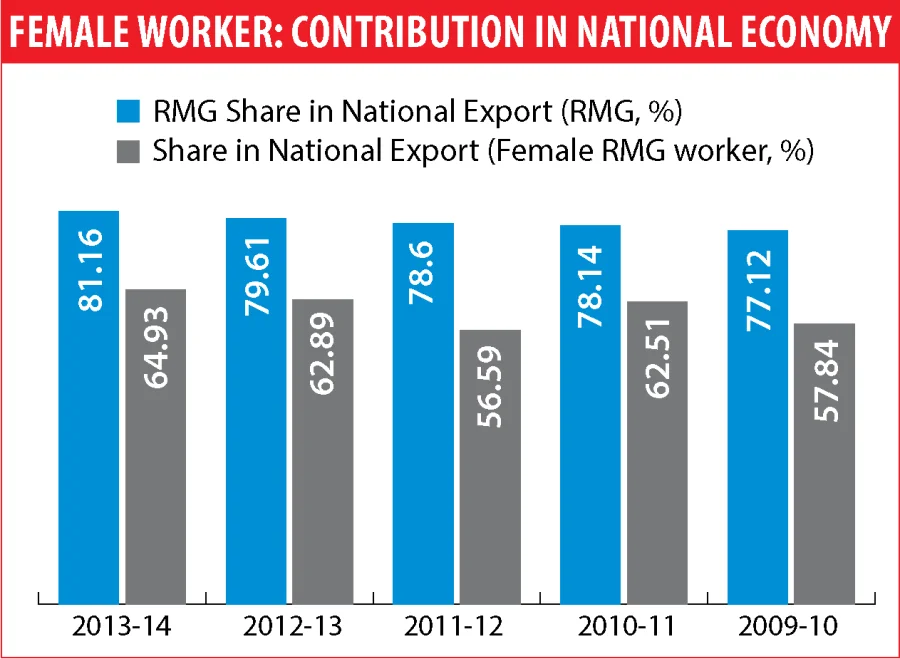
Comparatively RMG share in national export was 81.16% the same year.
A ripple effect of economic growth fueled by a woman led labour force produced a dramatic increase in financial freedom for women.
However, before the pandemic 71% of garment worker’s salaries would be exhorted by their husbands.
Currently, due a government mandate intended to limit contact during the pandemic, the majority of the labour force currently own bank accounts. This is a huge advancement as only 26% of the labour force previously held bank accounts and 95% of them lacked knowledge of financial services.
Bank accounts encourage financial independence for women garment workers.
Therefore, Bkash's collaboration with banks can enable women to claim their share of the national income.
Women are more likely to be self-employed in Bangladesh as they disproportionately own less of the national income.
Therefore, microfinancing had targeted women specifically to reduce chances of defaulting and to empower self-employed women.
However, 78% of the husbands in a survey conducted by CPD claimed that they had used their wife’s loans to generate their own income.
Only 5% of the women that take out micro-credit loans have total control over their loans and 56% share control with their husband, while 38% give full control of their finances to their husbands.
This is a result of a patriarchal system that perpetuates gender inequalities via the practice of village exogamy.
Thus, isolating women, which allows husbands to exploit them financially. Despite the credit systems and government policies being exhausted to empower women, the lack of financial literacy prevents them from fully exercising financial independence.
Savings are also instrumental in establishing financial stability for women.
According to Ashraful Alam, country coordinator of the United Nations Capital Development Fund, savings also ensure financial security for women.
Despite the contributions made by women in both the RMG and agriculture sectors, savings and loans are still managed by husbands.
Therefore, to ensure women have access to financial security, management of savings should be taught to women.
Given that 42% of the women do not have saving accounts and 85% of the women reported they cannot autonomously use their savings, women remain disengaged to available financial services.
Nearly 65% of the agricultural workforce is conducted by women, yet the earnings and labour recognition are received by their partners instead.
This reveals the deep-seated patriarchy that plagues women in Bangladesh despite the recent advancements they have made in securing financial stability.
Women in politics have increased significantly over the past decade.
As a result of women holding positions in the upper echelons of society, there has been a surge in the number of initiatives taken by the government. The government's adolescent girls’ program is one such initiative that can inculcate the necessary cultural capital like financial and legal literacy into young girls.
This program aims to educate girls regarding reproduction, gender-equitable behavior and provide cash incentives.
Educating women not just academically but also in regard to their personal finances and rights is a key proponent in tackling the lack of financial literacy and independence women have even when given economic opportunities.
The new generation of RMG and agricultural workers would need to not only have the technical skills but financial knowledge about savings and credit loans for socio-economic advancement to be realized.
Humaira Aziz is one of the few women that took up the initiative of teaching women about the financial options available to her “Sonchita” app.
Often the contribution women make to the economy is undervalued in the domestic, formal and informal sectors.
Therefore, knowledge of financial services can slowly erode the patriarchal barriers that prevent social change from materializing.
Furthermore, the rapid GDP growth can be attributed to the women-driven RMG and agriculture labour forces.
As a result, politicians and grassroots activists such as Aziz can not only impart knowledge in securing women's finances but also ensure women are also part of the economic growth that women have propelled.
The author is an intern at the Bangladesh Enterprise Institute