Economy started faltering and losing steam from the middle of the outgoing year despite political calm in the country and a grim outlook for sluggish global economy.
When international and regional economies suffer for rising trade and geopolitical tensions, the local economy cannot stay immune, with the lack of leadership and effective regulatory roles weighing on business, investment and domestic demand, say analysts.
Soaring bad debts, negative export growth and less than estimated credit disbursement put a dent in the economy, posing a threat to achieving the estimated 8.20% economic expansion in the current fiscal year, apprehend economists.
“It is not possible to attain the 8.20% projected GDP only with the good remittance inflows, as it would contribute to only consumption,” Zahid Hussain, former lead economist at the World Bank Dhaka office, told Dhaka Tribune.
Economic indicators like import growth, revenue earnings including value added tax (VAT) collection, inflation and domestic demand all registered lackluster performance in the given year, particularly from July to November.
Stock market grounded to rock bottom in its index, frustrating both investors and policymakers.
The government borrowed the whole of the yearly target in the first five months of the current fiscal year from the banks, due to record revenue shortfall.
During July-October period of the current fiscal, VAT collection was Tk28,752 core, up by only 1.8% over the same period of last fiscal year.
Poor VAT collection suggests the contraction in factory activities and poor domestic demands from consumers.
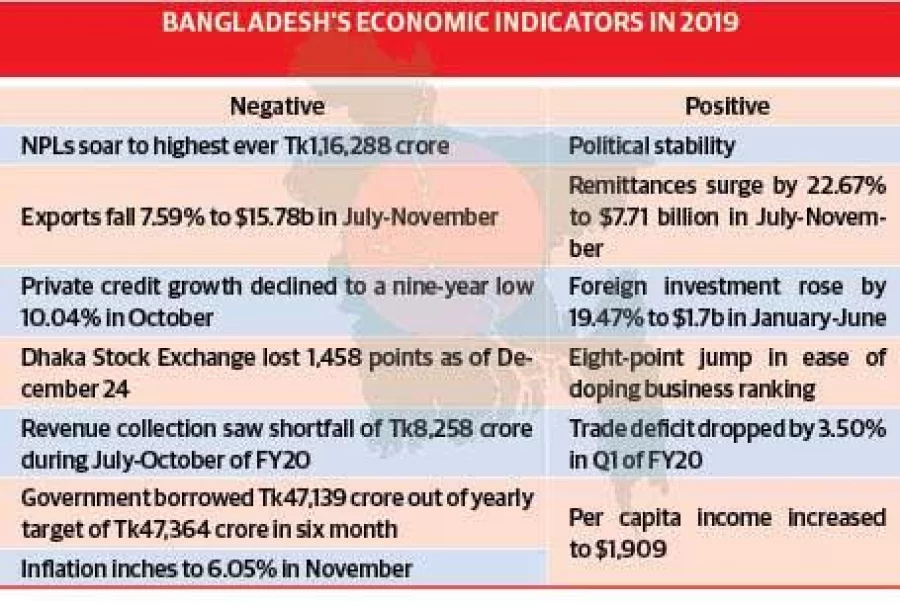
Although the government set the target to keep the inflation rate at 5.5% for the current fiscal year, it inched up to 6.05% in November, putting extra financial burden on diverse groups of people.
Almost all food items, including onion, saw a big leap in their prices in the outgoing 2019.
In contrast, Foreign Direct Investment (FDI) and the World Bank’s Ease of Doing Business 2020 ranking showed light in the tunnel.
The country made an eight-point jump in the World Bank’s Ease of Doing Business 2020 ranking. The country is now placed 168th out of 190 countries.
“Bangladesh’s main economic storyline in 2019 was soaring non-performing loans (NPLs) and lack of good governance in the financial sector, which made the banking sector sick, creating liquidity crisis and sending the private sector credit growth to nine-year low,” Zahid Hussain said.
Growing default loans also shattered the bankers’ confidence in lending to new investors as they cannot differentiate between good and bad borrowers, adds Zahid.
As of September, NPLs in the banking sector stood at record Tk1,16,288 crore, the highest ever in the country’s history. As of October, private sector credit growth dropped to 10.04%, a nine-year low, against the target of 14.80% growth for the current fiscal year.
“In the outgoing year, there was hardly any sector without financial stress. This is very uncomfortable situation for the country’s economy and the business community,” says Policy Research Institute (PRI) Executive Director Ahsan H Mansur.
“I can say that the state of the country’s banking sector is a matter of great concern. Absence of compliance in the banking industry has caused the situation worse,” adds Mansur, also the chairman of Brac Bank.
Mustafizur Rahman, distinguished fellow, Centre for Policy Dialogue (CPD), has told Dhaka Tribune that the country’s economy is integrated with the international economy, where balance of payment, negative growth in export earnings and lack of product diversification are very big economic malaises.
To attract FDI, increase export earnings and boost business competitiveness, the government has to fix the protracted challenges in the areas of good governance in the financial sector, soaring NPLs and declining private sector investment, he adds.
“I think the country maintained stability in fiscal management, monitoring, and economic fundamentals for years which lost shines to a great extent in the outgoing year. With these weaknesses we are going to enter into 2020," says Rahman.
In the current budget, the government vowed to boost revenue collection by implementing the Value Added Tax and Supplementary Duty Act, 2012. But it could not implement the act so far due to regulatory weakness and leadership bankruptcy in the fronts of policymaking and enforcement, believes a former revenue board chairman.
“It was assumed that the implementation of new VAT act would help augment revenue generation but it did not happen. In the first quarter of the FY20, the gap between the target and revenue collection widened,” says Zahid Hussain further.
According to National Board of Revenue (NBR) data, in July-October period of the current fiscal, the country earned Tk65,096.46 crore revenue against the target of Tk85,317 crore. The first four months' revenue shortfall stood at Tk20,220.75 crore.
As the government failed to generate estimated revenue, this will put pressure on bank borrowing, he points out, adding that the budget deficit will otherwise increase to 7% to 8% of gross domestic product.
For the current fiscal year, the government set the target to borrow Tk47,364 crore from the banking sector, of which the government already borrowed Tk47,139 crore as of December 9, 2019.
As an export-led economy, continuous negative growth in exports in the last four month has made the exporters as well as the policy makers worried.
Despite having opportunity to grab more from the US-China trade war, the country failed to keep up the positive growth that was seen in the first half of the year.
According to the Export Promotion Bureau data, during July-November period of the current fiscal, exports saw a 7.59% negative growth to $15.78 billion.
“There was a huge price pressure on manufacturers as the production cost went up by close to 30% due mainly to new wage structure, which was not adjustable by even a single exporter. But buyers did not increase prices of apparel goods. As a result, Bangladesh lost competitiveness and failed to grab work orders,” Sharif Zahir, a director, BGMEA, has told Dhaka Tribune.
In addition, appreciation of the Taka against US dollar has gobbled up Bangladeshi exporters’ competitiveness to its competing countries, as all the counterpart nations already devalued their respective currencies to promote their exporters, adds Zahir.
On the other hand, global apparel retailing businesses saw drastic fall in sales and big retailers suffered a lot. Fast fashion products on which Bangladeshi exporters are highly dependent have become unpopular, while the export destination economies are on a downswing, he maintains.
Although the country’s trade deficit dropped in the first quarter of the current fiscal year, it did not bring any positive news for the economy.
In July-September of the current fiscal year, the country’s trade deficit dropped by 3.50% year-on year to $3.71 billion.
On January 24, the DSEX touched the highest peak of 5,950 points but as of December 24 the stock market lost 1,458 points.
In the outgoing year, foreign investors sold off the shares, especially in large companies including Grameenphone, Olympic Industries, United Power Generation, British American Tobacco Bangladesh and Square Pharmaceuticals, says Bangladesh Securities and Exchange Commission (BSEC) Chairman M Khairul Hossain.
These pressures have caused the downtrend in the stock market as these five companies accounted for 80% of the market slide, he claims.
Positive indicators in economy
Amid crisis and weakness in the macro economy, there were some good stories in 2019.
One of the most positive factors in the country’s macro economy in 2019 was a significant rise in remittance inflow. It was due to the government’s incentives against the remittance sent through banking channel.
As per Bangladesh Bank (BB) data, during July-November period of the current financial year, Bangladesh received $7.71 billion, up by 22.67%, which was $ 6.29 billion in the same period a year ago.
Another good news for the economy was sharp rise in FDI, which businesspeople and experts have attributed to government initiatives to improve ease of doing business and establishment of new economic zones.
However, Bangladesh still remains at the bottom among the South Asian countries in wooing FDI.
According to BB, during January-June of 2019, the net inflow of overseas investment stood at $1.70 billion, up by 19.47%, which was $1.41 billion in the same period last year.
In the World Bank’s Ease of Doing Business 2020 ranking, Bangladesh moved up by eight notches at 168th from 176 this in the previous one.
In the last fiscal year, Bangladesh registered 8.15% GDP growth, which was 7.86% in FY18. The government estimated to clock 8.20% growth in the current 2019-20 fiscal year.
However, Zahid says the country should be happy if it can achieve the WB’s projected 7.2% growth for the current fiscal year.
The International Monetary Fund in its October projection forecast global growth at 3% for 2019, its lowest level since 2008–09 and a 0.3 percentage point downgrade from the April 2019 World Economic Outlook
In first four months of the current fiscal year, the country’s imports saw a 3.17% decline to $18.13 billion, which was $18.73 billion in the same period last year.